

Luxury homes used to show technology proudly.
Touch panels on walls.
Motorised curtains.
Visible speakers.
Security cameras.
Mood lighting controls.
Smart appliances.
Voice commands.
Remote-operated systems.
Screens everywhere.
For a time, this felt impressive.
The more technology a home displayed, the more advanced it seemed.
But luxury is changing.
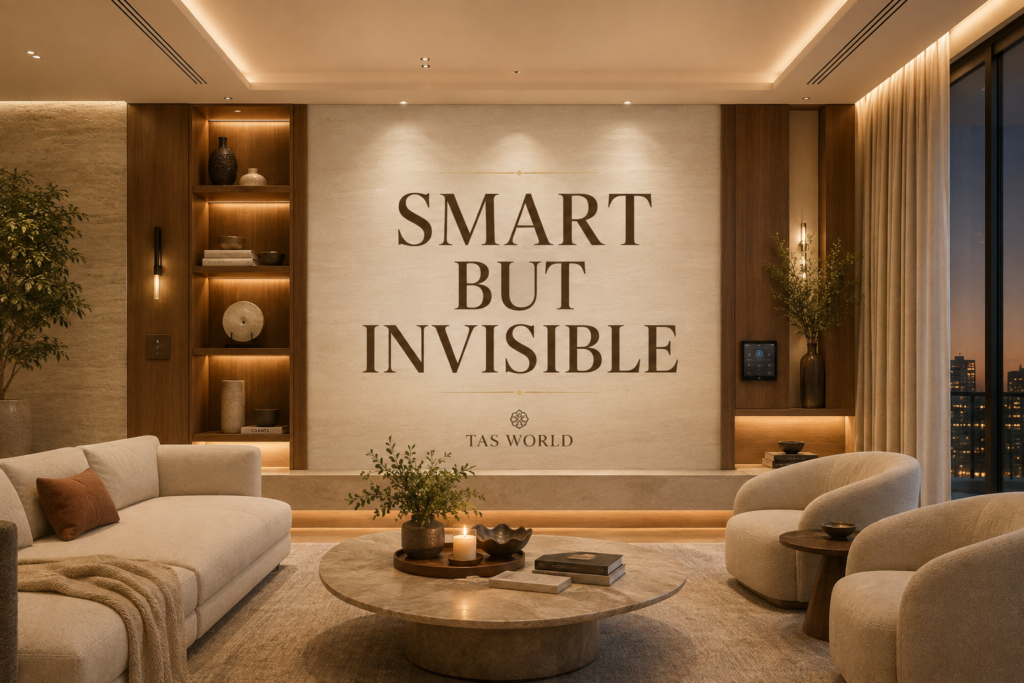
The future smart home is not the home where technology is constantly visible.
It is the home where technology quietly disappears into comfort, safety, privacy, lighting, climate, security, and daily ease.
That is why invisible smart homes are replacing show-off technology in luxury living.
Smart Luxury Is Becoming Quieter
The first phase of smart homes was about novelty.
Can the curtains open automatically?
Can the lights change colour?
Can the AC be controlled from a phone?
Can the door unlock remotely?
Can music play in every room?
Can cameras be viewed from anywhere?
These features still have value.
But the luxury client has matured.
A high-end homeowner does not want to manage a house like a gadget showroom.
They want the home to work.
Quietly.
Reliably.
Intuitively.
Without unnecessary effort.
A luxury smart home is not defined by how much technology it displays.
It is defined by how gracefully technology improves life.
Technology Should Simplify, Not Complicate
This is the first rule.
If a smart home makes basic living harder, it has failed.
If a person needs an app to do everything, the system is not intelligent.
If lights are confusing, the home is not luxurious.
If elders cannot use the controls, the system is badly planned.
If staff cannot manage cleaning mode, service becomes inefficient.
If guests cannot understand switches, the home becomes awkward.
If the Wi-Fi fails and the house becomes difficult to operate, the technology is too fragile.
Smart technology is luxury only when it removes friction.
If it adds dependence, confusion, or irritation, it is not smart.
It is expensive inconvenience.
The Best Technology Is Felt, Not Seen
The finest smart-home systems are almost invisible.
You do not notice them as gadgets.
You notice them as comfort.
The room is at the right temperature.
The lights feel perfect in the evening.
Curtains reduce glare automatically.
Security is strong but discreet.
The outdoor lights guide movement safely.
The home office is ready for a call.
The pooja room glows softly at the right time.
The bedroom shifts into night mode.
The AC does not fight the sun.
The home feels calm during hosting.
That is invisible intelligence.
Technology has done its job when the family does not have to think about it constantly.
Show-Off Technology Ages Quickly
Visible technology dates faster than architecture.
A panel that looks futuristic today may look outdated in five years.
A bulky screen can disrupt a refined wall.
A visible speaker can weaken a ceiling composition.
A poorly placed camera can make a home feel watched.
A glowing control panel can disturb a quiet bedroom.
A smart appliance can become irritating if the app stops working or the interface changes.
This is why technology should not become the visual identity of a luxury home.
Architecture should lead.
Materials should lead.
Light should lead.
Comfort should lead.
Technology should support.
Not dominate.
Lighting Is the First Smart-Home Layer
The most valuable smart-home system is often lighting.
Not because it is dramatic.
Because it affects every day.
A serious luxury home needs lighting scenes.
Morning.
Evening.
Dining.
Hosting.
Movie.
Reading.
Pooja.
Cleaning.
Night.
Outdoor gathering.
Work.
Guest arrival.
These scenes should not be complicated.
A single button should make the room feel right.
The living room should shift from family mode to hosting mode.
The dining room should become intimate.
The bathroom should move from grooming light to recovery light.
The bedroom should soften at night.
The outdoor kitchen should become usable after sunset.
The staircase should stay safe without glare.
This is where technology becomes emotional.
It lets the home respond to time.
Smart Climate Control Matters in India
In Indian luxury homes, climate control is not a luxury extra.
It is central to comfort.
Heat.
Dust.
Monsoon.
Humidity.
Winter.
Strong sun.
Large glass openings.
Outdoor-indoor transitions.
Basements.
Bathrooms.
Wardrobes.
Home offices.
All of these need climate intelligence.
A smarter home can support:
- zoned air-conditioning
- automated blinds
- temperature scheduling
- humidity monitoring
- energy-efficient scenes
- sensor-based control
- ventilation support
- seasonal programming
- air quality awareness
- reduced glare and heat gain
But this must be planned with architecture.
Technology cannot compensate for poor shading, bad ventilation, weak insulation, or wrong material choices.
The best smart homes combine passive design and active systems.
They do not use automation to cover design mistakes.
Security Must Be Strong, But Discreet
Luxury homes need security.
But security should not make the home feel like a surveillance facility.
A strong security system may include:
- gate control
- visitor access
- CCTV
- video door phone
- motion sensors
- door sensors
- smart locks
- staff access permissions
- panic buttons
- perimeter alerts
- garage and basement monitoring
- service entry control
- remote monitoring where appropriate
But all of this must be discreet.
Cameras should not dominate beautiful elevations.
Panels should not interrupt walls.
Sensors should be integrated carefully.
Access control should be clear but not aggressive.
The home should feel safe.
Not suspicious.
Luxury security is layered.
But it should remain calm.
Privacy Is the New Smart-Home Luxury
Privacy is one of the most important smart-home subjects.
A luxury home is deeply personal.
It includes bedrooms, bathrooms, wardrobes, family lounges, pooja rooms, children’s rooms, staff areas, offices, guest suites, and private conversations.
Smart devices can collect data about movement, habits, schedules, voices, guests, staff, and daily routines.
This creates a serious question.
Who controls the data?
Who has access?
What is recorded?
What is stored?
What is cloud-based?
What works locally?
What can staff see?
What can vendors access?
What happens during maintenance?
A smart home that ignores privacy is not truly luxurious.
It may be convenient.
But it is not refined.
In high-end homes, privacy must be designed into the system from the beginning.
Staff and Guest Permissions Matter
Indian luxury homes often include staff-supported living.
That makes smart-home planning more complex.
Staff may need access to:
- service entry
- utility room
- kitchen
- cleaning mode
- outdoor lights
- certain AC zones
- laundry areas
- security gates
- selected rooms at selected times
But they may not need access to:
- private bedrooms
- wardrobes
- safes
- primary bathroom zones
- personal office areas
- family-only scenes
- camera feeds
- personal data
A good smart-home system should allow hierarchy.
Owner access.
Family access.
Staff access.
Guest access.
Vendor access.
Temporary access.
Emergency access.
This is not about distrust.
It is about clarity.
A luxury home should not depend on giving everyone full control.
Manual Fallback Is Essential
This is where many smart homes fail.
Every important system should have a manual fallback.
Lights should work from switches.
Curtains should be operable when needed.
Doors should have safe access options.
Security should not fail if one device loses connection.
AC should not depend entirely on an app.
Elders should not need a phone to use basic functions.
Staff should not need passwords for daily work.
Guests should not feel helpless.
Technology should add convenience.
It should not remove basic independence.
A luxury smart home must work even when:
- Wi-Fi fails
- phone battery dies
- app updates create errors
- power backup mode starts
- the owner is travelling
- staff needs simple operation
- guests are staying
- elders are using the house
- maintenance is underway
Reliability is more luxurious than novelty.
Smart Homes Must Be Planned Early
Automation cannot be treated as a late-stage add-on.
It affects:
- wiring
- switches
- lighting circuits
- curtain tracks
- sensors
- CCTV
- Wi-Fi access points
- speakers
- HVAC controls
- security wiring
- network racks
- backup power
- ceiling design
- wall panels
- access panels
- service rooms
- maintenance routes
If automation is planned late, the home suffers.
Walls are cut again.
Conduits appear.
Switchboards become crowded.
Sensors are badly placed.
Curtain motors look exposed.
Access panels break clean ceilings.
Wi-Fi becomes weak in key rooms.
Lighting scenes become limited.
A serious luxury smart home should be planned before plaster, before false ceilings, before final cabinetry, and before lighting is frozen.
Invisible technology needs early coordination.
Network Planning Is the Hidden Foundation
A smart home is only as good as its network.
Many homes spend heavily on visible automation but ignore the invisible backbone.
Weak Wi-Fi.
Poor router placement.
No wired access points.
Bad rack ventilation.
Messy cables.
No labelled circuits.
No UPS support.
No planned service access.
No security segmentation.
No future expansion.
This creates problems later.
A luxury home should have a serious technology backbone.
Network rack.
Structured cabling.
Proper Wi-Fi access points.
Backup power.
Cooling for equipment.
Clear labelling.
Service access.
Privacy-aware configuration.
Future-ready conduits.
The most invisible part of the smart home is often the most important.
Smart Homes Should Support Ageing and Safety
Invisible smart-home planning can also support family safety.
Especially in multigenerational homes.
It can help with:
- low-level night lighting
- motion-based corridor lights
- elder-friendly switches
- bathroom safety alerts
- fall-aware planning where appropriate
- bedroom emergency buttons
- door sensors
- medication reminders where suitable
- safe stair lighting
- gentle wake-up scenes
- visitor screening
- staff call buttons
This is not gadget luxury.
It is care.
A luxury home should support elders and children without making the house feel institutional.
Good technology can provide safety quietly.
Smart Kitchens and Utility Rooms Need Restraint
Smart technology can help kitchens and utility rooms.
But it must be practical.
Useful smart systems may include:
- appliance circuits
- energy monitoring
- leak detection
- ventilation control
- utility room humidity sensors
- water overflow alerts
- smoke detection
- pantry lighting
- service mode lighting
- outdoor kitchen controls
- irrigation systems
- waste area ventilation
But unnecessary app-heavy appliances can become irritating.
Not every refrigerator needs to be a screen.
Not every appliance needs a cloud connection.
Not every process needs automation.
The best luxury homes are selective.
They automate what improves life.
They avoid what only creates novelty.
Smart Bathrooms Require Careful Thinking
Bathrooms are private spaces.
So technology must be integrated sensitively.
Useful features may include:
- mirror demisters
- warm lighting scenes
- night lighting
- exhaust automation
- floor heating where suitable
- water temperature control
- leak detection
- humidity sensors
- smart geyser scheduling
- ventilation triggers
But bathrooms should not feel surveilled.
Privacy matters more here than almost anywhere.
A bathroom should feel safe, personal, and quiet.
Not like a tech environment.
Smart Bedrooms Should Help Rest
Bedrooms are not places for gadget display.
They should support sleep, privacy, and calm.
A smart bedroom may include:
- night mode
- blackout curtains
- low-level path lighting
- AC scheduling
- reading lights
- silent switches
- gentle wake-up lighting
- privacy controls
- panic button
- no unnecessary glowing panels
The best bedroom technology disappears before sleep.
It should not create visual noise.
It should not demand attention.
A bedroom should feel less connected, not more.
Smart Home Offices Need Presence and Privacy
The private home office has become one of the most important smart zones.
It may need:
- video-call lighting
- acoustic support
- reliable internet
- background lighting
- privacy control
- screen glare management
- charging
- concealed wiring
- secure storage
- controlled access
- power backup
- sound isolation
This is where smart-home planning directly supports work, authority, and confidentiality.
But again, the technology should not dominate the office.
It should make the room perform better.
Outdoor Smart Systems Should Be Weather-Ready
Outdoor spaces need a different technology logic.
Terraces, gardens, outdoor kitchens, pool decks, and driveways may need:
- landscape lighting
- irrigation control
- security sensors
- weather-rated speakers
- outdoor kitchen power
- gate automation
- driveway lighting
- pool controls
- terrace fans
- mosquito-control planning where appropriate
- weather-safe switches
- drainage alerts
- outdoor cameras
Everything outdoors must be specified for heat, dust, rain, and maintenance.
Indoor technology cannot simply be moved outside.
A luxury outdoor smart system must be climate-aware.
Technology Should Protect Energy, Not Waste It
Smart homes should not only be convenient.
They should also be efficient.
Lighting scenes can reduce unnecessary energy use.
Automated curtains can reduce heat gain.
AC scheduling can prevent waste.
Occupancy sensors can switch off unused zones.
Energy monitoring can identify waste.
Smart irrigation can reduce water misuse.
Geyser scheduling can avoid unnecessary heating.
Outdoor lighting can be timed and zoned.
This is where smart-home planning connects with sustainability.
A luxury home should not be wasteful just because it can afford to be.
The next generation of luxury is more intelligent than that.
The Danger of Over-Automation
There is such a thing as too much automation.
When every small function becomes automated, the home can feel less human.
Too many sensors.
Too many apps.
Too many notifications.
Too many panels.
Too many modes.
Too many dependencies.
Too many systems that require specialist support.
The home starts to feel managed instead of lived in.
A luxury smart home should have restraint.
Some things should be automated.
Some things should remain simple.
Some controls should be physical.
Some scenes should be preset.
Some systems should stay invisible.
The question is not, “Can this be automated?”
The question is, “Should this be automated?”
The Indian Luxury Home Context
This topic is especially important in Indian luxury homes.
A high-end Indian residence may include:
- multiple family members
- elders
- children
- staff
- guests
- service entries
- basements
- terraces
- outdoor kitchens
- pooja rooms
- home offices
- dressing suites
- guest suites
- entertainment rooms
- security needs
- privacy expectations
- seasonal climate shifts
This makes smart-home planning more complex.
A copied global smart-home system may not work well.
Indian homes need automation that understands Indian living.
Staff access.
Power backup.
Dust.
Heat.
Monsoon.
Privacy.
Multiple generations.
Formal and informal zones.
Guest stays.
Security.
Outdoor use.
Pooja rituals.
Service movement.
Luxury home design India must integrate technology into this reality.
Not install gadgets after the fact.
What Smarter Luxury Homes Do Differently
1. They Make Technology Invisible
The home feels intelligent without looking like a tech showroom.
2. They Use Automation to Remove Friction
Lighting, climate, security, curtains, and access control make daily life easier, not more complicated.
3. They Plan the Backbone Early
Wiring, network, power backup, racks, sensors, switches, and services are coordinated before interiors are finished.
4. They Protect Privacy
Data, cameras, access permissions, staff controls, guest access, and vendor access are considered carefully.
5. They Keep Manual Controls
Important functions still work through simple physical controls and fallback systems.
6. They Design Room-Specific Intelligence
Bedrooms, kitchens, bathrooms, offices, pooja rooms, outdoor areas, and utility rooms all need different smart logic.
7. They Avoid Gadget Theatre
The home does not chase every feature just because it exists.
8. They Plan for Maintenance
Technology racks, drivers, circuits, panels, sensors, and systems remain accessible and serviceable.
The New Definition of a Luxury Smart Home
A luxury smart home is not the one with the most devices.
It is the one with the least friction.
It supports:
- comfort
- privacy
- safety
- lighting
- climate
- energy
- security
- access
- maintenance
- family routines
- staff clarity
- guest ease
- seasonal performance
It does not need to look futuristic.
It needs to feel effortless.
The best smart homes are not impressive because they show technology.
They are impressive because the technology has disappeared into the way the home works.
Conclusion
Invisible smart homes are replacing show-off technology in luxury living because homeowners no longer want novelty for its own sake.
They want ease.
Privacy.
Comfort.
Security.
Reliability.
Energy intelligence.
Lighting that adapts.
Climate that responds.
Access that feels controlled.
Systems that work without constant attention.
The future luxury smart home is not about panels, apps, and gadgets everywhere.
It is about a home that quietly understands life.
A home that supports morning routines, evening calm, hosting, work, prayer, rest, safety, and seasonal change.
A home where technology is present, but not dominant.
Because true smart luxury is not the home that shows off intelligence.
It is the home that quietly removes friction from life.