
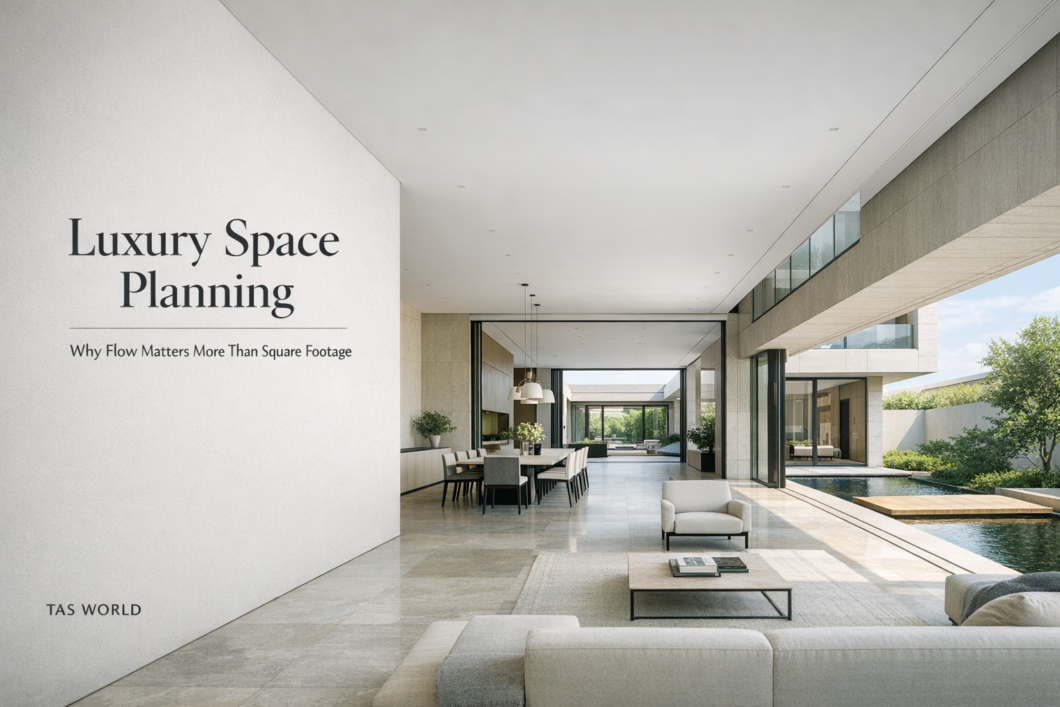
How many square feet ?
It is the most common question in luxury real estate.
But it is rarely the most important one.
In 2026, sophisticated homeowners are beginning to understand something fundamental:
Size is arithmetic.
Flow is architecture.
Two homes with identical built-up areas can feel radically different. One may feel constrained and fragmented. The other expansive and effortless.
The difference lies in spatial intelligence.
Luxury residential architecture is not defined by area. It is defined by how space moves.
What Is Architectural Flow?
Architectural flow is the continuity of movement, sightlines, light, and proportion within a home.
It is how one space transitions into another.
It is how natural light travels.
It is how circulation feels intuitive rather than forced.
Flow is not accidental.
It is the result of deliberate planning.
Luxury home design in India increasingly emphasizes experiential movement over numeric size. Homes that feel seamless command higher emotional and market value.
Why Bigger Homes Often Feel Smaller
Many large homes fail to feel luxurious because they lack spatial hierarchy.
Common issues include:
Long, disconnected corridors
Oversized rooms without proportion
Low ceiling uniformity
Abrupt transitions between spaces
Dead corners with no functional logic
Square footage without rhythm creates fragmentation.
Luxury villa architects in India understand that repetition without variation reduces perceived scale. True spatial richness comes from contrast and layering.
A smaller, well-planned home often feels grander than a poorly organized mansion.
Compression and Expansion: Creating Perceived Scale
One of the most powerful architectural tools is spatial contrast.
A slightly compressed passage can lead into a double-height living space.
A low ceiling foyer can open into a sunlit courtyard.
A narrow approach can reveal an expansive garden.
This rhythm of compression and expansion enhances perceived scale.
The architecture of arrival relies on this technique. So does effective interior planning.
Luxury is often about what unfolds gradually.
Zoning Intelligence: The Invisible Framework
High-end homes require clear zoning between:
Public spaces
Private spaces
Service areas
Entertainment zones
Daytime and nighttime functions
Poor zoning leads to overlapping noise, visual intrusion, and discomfort.
Strong zoning creates clarity.
Bedrooms remain insulated from social areas. Kitchens connect seamlessly to dining but remain visually controlled. Study areas maintain acoustic separation.
Residential architects in Delhi NCR increasingly focus on spatial logic before material selection.
Flow begins with structure.
Indoor-Outdoor Integration
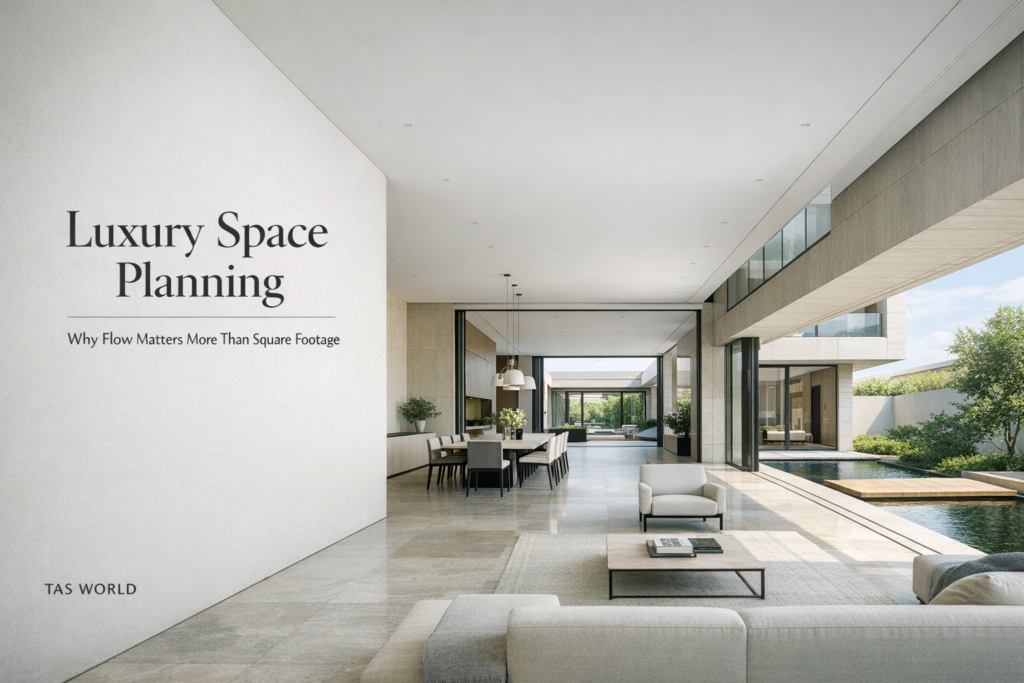
Modern luxury homes extend beyond interior walls.
Courtyards, terraces, and landscaped edges expand usable space psychologically and physically.
When interior sightlines connect to outdoor elements:
Rooms feel deeper
Natural light increases
Air circulation improves
Visual monotony reduces
Luxury residential architecture in India increasingly integrates landscape into spatial planning.
Flow does not stop at the façade.
Light as a Spatial Connector
Natural light is one of the most powerful tools in space planning.
When windows align along visual axes, light travels further. When ceiling heights vary strategically, light reflects differently.
Proper orientation enhances:
Depth perception
Material texture
Mood stability
Ventilated façade systems and climate-responsive planning also influence how light enters and diffuses.
Homes that manage light intelligently feel larger than their footprint.
Light expands space without adding area.
Circulation Without Waste
In poorly planned homes, circulation space becomes wasted square footage.
Long corridors with no visual interest reduce usable experience.
In refined space planning:
Circulation zones double as galleries
Staircases become sculptural transitions
Visual connections eliminate unnecessary walls
Flow minimizes wasted movement.
This increases functional efficiency while maintaining openness.
Flow and Property Value
Buyers rarely articulate spatial flow during property visits. Yet they feel it immediately.
A home that moves effortlessly feels sophisticated.
A home that feels cramped despite size raises subconscious hesitation.
In competitive luxury real estate markets, emotional response influences pricing power.
Design-led real estate depends heavily on spatial intelligence.
Square footage can be matched by competitors.
Flow cannot be easily replicated.
Why Integrated Planning Matters
Space planning intersects with:
Structural design
Mechanical systems
Lighting strategy
Landscape integration
Without coordination, ducts disrupt ceilings. Columns interrupt sightlines. Drainage slopes conflict with layout.
Design-build firms in Delhi NCR often maintain stronger spatial integrity because planning and execution are aligned from early stages.
Luxury requires discipline.
The 2026 Luxury Mindset
Today’s high-net-worth homeowners are more design-aware.
They understand that:
A 5,000 sq ft home with intelligent flow can outperform a 6,500 sq ft home with poor planning.
They value:
Proportion
Hierarchy
Light
Movement
Silence
Integration
Luxury home design in India is shifting from measurement to experience.