

In many homes, art arrives at the end.
The sofa is selected.
The marble is installed.
The curtains are fixed.
The lights are placed.
The walls are painted.
The furniture is arranged.
Then someone looks at an empty wall and says, “We need something here.”
That is where most homes go wrong.
In a serious luxury home, art is not a late accessory.
It is not a wall filler.
It is not simply decoration above a console.
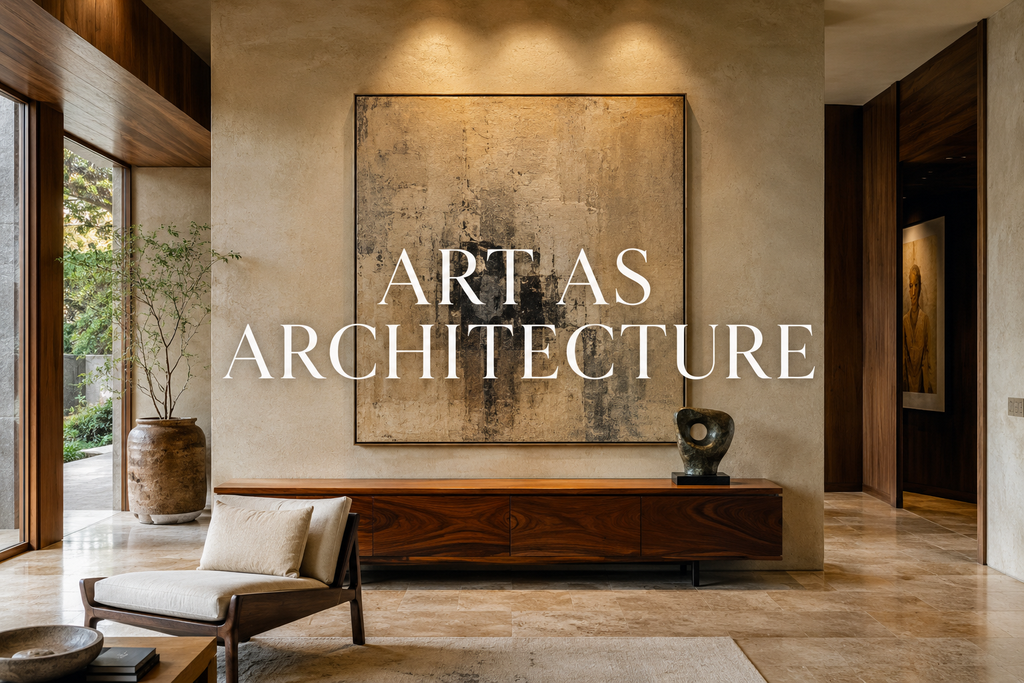
Art placement is becoming architecture because it shapes how walls are designed, how lighting is planned, how rooms are composed, how movement is guided, and how the home expresses the family’s identity.
A luxury home should not look decorated with art.
It should feel architecturally composed around art.
Art Is No Longer the Final Layer
The old way of thinking was simple.
Finish the interiors first.
Then buy art.
Then hang it wherever the wall looks empty.
That approach may work for casual décor.
It does not work for high-end home interiors.
If art matters to the home, it should be discussed before the wall is finished.
Where will the main artwork sit?
How large should the wall be?
What will the viewing distance be?
Will the artwork need accent lighting?
Will the wall need reinforcement?
Will natural light damage the work?
Will the furniture support the composition?
Will the ceiling lighting align with the art?
Will the artwork be seen from the entry, dining area, staircase, or corridor?
These are not styling questions.
They are architectural questions.
The Market Is Moving Toward More Personal Interiors
Luxury interiors are moving away from safe showroom perfection and toward homes with stronger personality, memory, craft, art, and collected meaning.
Recent design coverage has repeatedly pointed toward individuality and personal conviction in interiors, with homes becoming less about safe sameness and more about pieces that carry personality, history, and emotional value.
Architectural Digest recently discussed how “good taste” is becoming more individual, more expressive, and less afraid of unusual personal choices. AD PRO’s 2026 interior forecast also points toward artists and personal stories becoming embedded into architectural finishes, with art and craft increasingly becoming part of the home itself rather than loose decoration.
This is exactly where art placement becomes important.
A home can have expensive finishes and still feel anonymous.
Art gives the home a point of view.
Art Gives a Home Identity
A luxury interior can be technically correct and still feel impersonal.
The materials may be premium.
The furniture may be custom.
The lighting may be warm.
The palette may be elegant.
But without identity, the home can feel like a beautiful hotel suite.
Art changes that.
It can express the family’s travels.
Their culture.
Their memories.
Their intellectual interests.
Their spiritual instincts.
Their taste.
Their humour.
Their heritage.
Their collections.
Their relationship with beauty.
Art tells the home’s story without explaining it.
This is why art should not be selected only because it matches the sofa.
It should belong to the life of the home.
Scale Is the First Test
Most art placement fails because of scale.
A small artwork on a large wall looks weak.
An oversized piece in a narrow corridor feels forced.
A gallery wall in the wrong room becomes clutter.
A painting above a sofa can look disconnected if it is too high, too small, or too narrow.
A sculpture can feel like an obstacle if its surrounding space is not planned.
Luxury art placement needs proportion.
It must study:
- wall size
- ceiling height
- viewing distance
- furniture scale
- corridor width
- frame depth
- artwork medium
- natural light
- artificial lighting
- room function
- circulation
- negative space
Art should not float randomly.
It should hold the room.
A well-scaled artwork can make a wall feel complete without making it busy.
A poorly scaled artwork can make even an expensive room feel unresolved.
Lighting Decides Whether Art Lives or Dies
Art needs the right light.
Not random downlights.
Not harsh spotlights.
Not glare.
Not shadows from the frame.
Not colour distortion.
The lighting must be planned around the artwork.
Some works need wall washers.
Some need accent lights.
Some need soft directional lighting.
Some need controlled natural light.
Some need glare protection.
Some need UV awareness.
Some should never be exposed to direct sunlight.
Lighting also affects how the artwork’s colour, texture, depth, and surface are perceived.
A textured canvas.
A metal sculpture.
A textile work.
A photograph.
A miniature painting.
A stone relief.
A ceramic piece.
Each behaves differently under light.
This is why art placement must connect to layered lighting.
The artwork, wall, ceiling, furniture, and lighting should be designed together.
Walls Should Be Designed for Art
A luxury wall is not only a surface.
It can frame memory.
It can hold art.
It can create a pause.
It can anchor a room.
It can guide movement.
It can become part of the family’s cultural expression.
When art is planned early, walls become more intelligent.
The wall can be kept calm.
The panel lines can align.
The lighting can be hidden.
The console can be scaled properly.
The artwork can breathe.
The view from another room can be considered.
The surface material can support the piece.
When art is planned late, the wall often becomes awkward.
Switchboards interrupt the frame.
Downlights miss the art.
Panel grooves cut through the composition.
The artwork is hung too high.
The console is too large.
The wall finish competes with the piece.
The art looks like an afterthought.
This is why luxury homes need better wall architecture.
The wall should be ready to receive meaning.
Art Can Shape Movement
Art does not only decorate rooms.
It can choreograph movement through the home.
An entry artwork creates arrival.
A staircase piece creates pause.
A corridor series creates rhythm.
A dining artwork creates intimacy.
A bedroom artwork creates calm.
A study artwork creates identity.
A pooja-adjacent artwork creates reverence.
A double-height artwork creates vertical drama.
A sculpture can slow people down at the right moment.
This is spatial choreography.
The artwork becomes part of how the home is experienced.
People may not analyse it consciously.
But they feel it.
They know where the eye rests.
They know where the body pauses.
They know which wall has importance.
They know which room has memory.
That is architecture.
Art Is a Powerful Entryway Device
The entryway is one of the most important places for art.
It is the first emotional moment of the home.
But it must be handled carefully.
The entry artwork should not feel like hotel lobby décor.
It should not be too loud.
It should not block movement.
It should not expose the private life of the home too quickly.
It should not compete with the door, console, lighting, and floor pattern.
A good entry artwork creates a controlled first impression.
It tells guests that the home has taste.
But it also tells them that the home has restraint.
In luxury home design India, where guests, family, staff, and deliveries may all intersect at the entrance, the art must be placed with circulation and privacy in mind.
Staircases and Landings Can Become Art Moments
A staircase is not only vertical movement.
It is one of the most cinematic spaces in a luxury home.
Landings, half-landings, double-height walls, and stair voids can become powerful art locations.
But they need planning.
Viewing angle matters.
Lighting height matters.
Wall scale matters.
Safety matters.
Installation access matters.
Maintenance matters.
A painting placed on a staircase may be seen from below, above, and across the void.
A sculpture near a stair landing must not disturb movement.
A large wall work may need special fixing and lighting access.
This is where art placement becomes deeply architectural.
The staircase should not simply carry art.
It should frame it.
Dining Rooms Need Emotional Art
Dining rooms are often underestimated.
They are not only eating spaces.
They are conversation rooms.
They are hosting rooms.
They are memory rooms.
Art can give a dining room emotional depth.
A strong artwork behind the dining table can create intimacy.
A softer work can calm the mood.
A textured piece can add warmth.
A cultural work can make the room feel rooted.
A sculptural wall piece can create quiet drama.
But the placement must work with table size, pendant lighting, chairs, sideboard, circulation, and viewing distance.
If the artwork is too aggressive, the dining room feels restless.
If it is too weak, the wall feels unfinished.
The best dining art supports conversation without overwhelming it.
Bedrooms Need Quieter Art
Bedroom art should support rest.
This does not mean it has to be boring.
But it should understand the emotional purpose of the room.
A bedroom needs calm, privacy, softness, and personal connection.
The artwork may be abstract.
Minimal.
Textural.
Photographic.
Spiritual.
Landscape-led.
Deeply personal.
But it should not create visual noise.
It should not fight the bed-back wall.
It should not interrupt reading lights.
It should not make the room feel like a public gallery.
It should not create glare opposite the bed.
In bedrooms, art should lower the emotional temperature of the room.
It should help the mind rest.
Home Offices Need Art With Authority
A private home office is not only a workroom.
It is a place of focus, identity, and leadership.
The art here can be more intellectual.
More personal.
More collected.
More symbolic.
It may relate to travel, achievement, culture, philosophy, architecture, history, or a private passion.
But it must also consider video calls, lighting, acoustics, storage, and privacy.
The artwork behind a desk becomes part of the owner’s visible identity.
That makes it powerful.
It should not look generic.
It should not feel like a rented office.
It should not be selected only for colour matching.
A strong home office needs art with conviction.
Indian Homes Need Cultural Intelligence
Art in Indian luxury homes has a special role.
It can include:
- contemporary Indian art
- spiritual art
- sculpture
- textiles
- miniature-inspired works
- family portraits
- heirloom objects
- regional craft
- brass and stone pieces
- temple-inspired art
- modern abstraction
- photography
- collected objects from travel
- commissioned works
But the danger is over-theming.
Indian art does not need to make a home look ethnic.
It needs to make the home feel rooted.
A single powerful textile work may say more than an entire themed wall.
A quiet sculpture may carry more dignity than a loud feature panel.
A contemporary Indian artwork may sit beautifully inside a modern interior without becoming decorative cliché.
Culture needs restraint.
That is what makes it luxury.
Art and Craft Are Coming Closer
The boundary between art, craft, furniture, and architecture is becoming softer.
A wall finish can be artistic.
A handmade tile can tell a story.
A sculptural light can behave like art.
A carved screen can frame space.
A textile panel can become a focal wall.
A custom door can become a crafted object.
A stone relief can become architecture.
AD PRO’s 2026 interior forecast points toward artists and makers becoming part of architectural finishes, with personal stories and motifs rendered into permanent home surfaces.
This matters for TAS World’s design-build language.
Art is not always something framed and hung.
Sometimes it is built into the home.
Art Should Have Negative Space
Luxury art placement needs restraint.
Every wall does not need art.
Every artwork does not need spotlighting.
Every corridor does not need a gallery.
Every console does not need a painting above it.
Negative space is what allows art to breathe.
Without empty space, the home becomes noisy.
The eye needs rest.
A powerful artwork needs distance.
A sculpture needs air around it.
A gallery wall needs discipline.
A textured wall may need no art at all.
Luxury is not the number of artworks displayed.
It is the clarity of what deserves attention.
Art Should Not Be Chosen Only to Match the Sofa
This is one of the most common mistakes.
The room has beige upholstery, so the art must be beige.
The cushions are blue, so the painting must contain blue.
The wall is green, so the artwork must match green.
Matching is not the same as composing.
Sometimes the best art creates contrast.
Sometimes it creates tension.
Sometimes it introduces a colour not found elsewhere.
Sometimes it carries emotional weight rather than palette harmony.
Sometimes it is valuable because it does not behave politely.
A luxury home should not reduce art to colour coordination.
Art should belong to the home at a deeper level.
Art Placement Must Consider Protection
Luxury art needs care.
This is where placement becomes technical.
A work may need protection from:
- direct sunlight
- humidity
- dust
- strong AC airflow
- damp walls
- unstable fixing
- harsh cleaning
- smoke
- heat
- accidental impact
- children and pets
- water seepage
- poor framing
If the artwork is valuable, placement must also consider documentation, insurance, security, handling, and future maintenance.
A beautiful artwork installed badly is at risk.
The wall must support the weight.
The frame must be stable.
The lighting must be safe.
The location must be maintainable.
The cleaning staff must know how to care for it.
This connects directly to luxury maintenance planning before handover.
Delhi NCR Homes Need Art Planning Discipline
Delhi NCR luxury homes often have large walls, double-height spaces, basements, terraces, home offices, formal drawing rooms, family lounges, and multi-level circulation.
They also deal with dust, harsh sunlight, air-conditioning, winter smog, monsoon humidity, staff-supported maintenance, and frequent hosting.
This makes art placement more complex.
A large wall in a Delhi NCR home should not automatically become a marble feature wall.
It may be a better art wall.
A staircase should not be left blank because the interior team ran out of time.
It may become a key identity moment.
A basement lounge should not use art without humidity and lighting planning.
A terrace-facing room should consider sunlight and glare before placing valuable work.
This is why residential architects Delhi NCR and the best interior designers in Delhi must plan art as part of architecture, not simply styling.
The Risk of Showroom Art
There is a particular kind of art that weakens luxury homes.
Art that looks expensive but says nothing.
Art chosen only because it fills wall space.
Art that matches the furniture too perfectly.
Art hung at hotel-lobby scale in a private home.
Art that looks like it came with the furniture package.
Art that has no relationship to the family.
This is showroom art.
It may photograph well.
But it does not create belonging.
A true luxury home should feel authored, not staged.
The art should make the home less replaceable.
Art Can Become a Long-Term Collection
Some families buy art casually.
Others build collections over time.
Both can work.
But in luxury homes, it is useful to think long-term.
Can the home support future acquisitions?
Are there enough calm walls?
Can lighting adapt?
Are there storage areas for works not currently displayed?
Can pieces rotate seasonally?
Can sculptures be placed safely?
Can heirloom objects be protected?
Can children grow into the collection?
Can the home evolve without feeling cluttered?
A good home does not need to display everything at once.
It needs the intelligence to hold memory over time.
Art Gives Luxury a Human Scale
Luxury can become intimidating.
Large spaces.
Tall ceilings.
Heavy materials.
Formal rooms.
Impressive finishes.
Art humanises this scale.
It gives the room emotion.
It gives the wall memory.
It gives the home intimacy.
It makes the space feel lived in.
This is why art is especially important in high-end home interiors.
Without it, luxury can feel cold.
With the right art, luxury feels personal.
What Smarter Luxury Homes Do Differently
1. They Plan Art Early
They discuss major art moments before walls, ceilings, lighting, and furniture are finalised.
2. They Treat Art as Architecture
Art placement shapes walls, sightlines, lighting, circulation, and emotional rhythm.
3. They Respect Scale
The artwork is proportioned to the wall, room, ceiling height, furniture, and viewing distance.
4. They Light Art Properly
Wall washers, accent lights, glare control, and colour temperature are planned carefully.
5. They Use Negative Space
Not every wall needs art. The best pieces need room to breathe.
6. They Choose Meaning Over Matching
Art is selected for identity, memory, culture, and point of view, not only colour coordination.
7. They Protect the Work
Sunlight, humidity, dust, fixing, cleaning, airflow, and maintenance are considered.
8. They Let the Collection Evolve
The home is designed to support future art, rotating pieces, heirlooms, and collected objects.
The New Definition of Art Placement
Art placement is no longer just hanging a painting.
It is the design of attention.
Where should the eye rest?
Where should the body pause?
Where should the home reveal personality?
Where should silence be protected?
Where should memory be displayed?
Where should culture become visible?
Where should the family’s point of view appear?
These are the questions that turn art from decoration into architecture.
Conclusion
Art placement is becoming architecture in luxury homes because the best interiors are no longer satisfied with looking expensive.
They need identity.
Memory.
Point of view.
Cultural depth.
Emotional rhythm.
A luxury home may have beautiful materials, layered lighting, crafted furniture, and elegant finishes.
But art gives it authorship.
It tells the story of the people who live there.
It shapes how rooms are remembered.
It gives walls purpose.
It gives movement meaning.
It gives interiors soul.
The finest luxury homes do not use art to fill empty walls.
They use art to give the home a point of view.
Because true luxury is not only what a home costs.
It is what the home chooses to say.