

For many years, luxury home design in India was easy to recognise.
A grand façade.
Large rooms.
Imported marble.
High ceilings.
Heavy chandeliers.
Gold accents.
Designer furniture.
A dramatic staircase.
A formal drawing room.
A large kitchen.
A decorated mandir.
These signs still matter in some homes.
But they are no longer enough.
The meaning of luxury is changing.
Today’s luxury home is not defined only by how expensive it looks. It is defined by how intelligently it lives.
Privacy.
Wellness.
Climate comfort.
Storage.
Lighting.
Service flow.
Technology.
Craft.
Cultural grounding.
Maintenance.
Long-term ease.
These are becoming the real markers of a refined home.
That is why luxury home design in India is moving beyond visible expense.
The new Indian luxury home is not only larger, richer, or more decorated.
It is better planned.
The Luxury Buyer Has Changed
The Indian luxury housing market is becoming more mature.
Recent JLL data shows that premium and luxury residential segments gained momentum in Q1 2026, with major Indian urban markets recording year-on-year value gains between 8% and 20%. JLL also notes that demand is being driven by affluent buyers seeking spacious, technologically sophisticated, future-ready homes.
Another JLL report says India’s premiumisation journey has reshaped the housing market, with buyers shifting from volume-driven to value-driven growth. Delhi NCR stood out strongly, with premium housing reaching a 92% share in 2025.
This is important.
Luxury buyers are not only buying square footage anymore.
They are buying quality of life.
They are asking deeper questions.
Will the home protect privacy?
Will it age well?
Will it support wellness?
Will it work for family life?
Will it handle Indian weather?
Will it be easy to maintain?
Will the technology make life simpler?
Will the home feel personal?
Will the design still feel relevant after ten years?
The luxury buyer has changed.
So the meaning of luxury home design must change too.
Bigger Is Not Automatically Better
Size can create luxury.
A larger living room can feel generous.
A larger bedroom can feel calmer.
A larger kitchen can support hosting.
A larger plot can create privacy.
But size alone does not create refinement.
A large home can still feel chaotic.
A large living room can feel cold.
A large kitchen can be badly planned.
A large bedroom can lack comfort.
A large basement can become a damp, unused zone.
A large wardrobe can still be disorganised.
A large façade can still feel tasteless.
The new luxury question is not only:
“How big is the home?”
The better question is:
“How well does the home work?”
Bigger is not automatically better.
Better planned is better.
Privacy Is Becoming a Core Luxury
Privacy is now one of the strongest markers of luxury.
Not only external privacy from neighbours, roads, and surrounding buildings.
Internal privacy matters just as much.
A luxury home must think about:
- guest and family separation
- staff circulation
- private bedrooms
- guest suites
- entryway filtering
- formal and informal zones
- home office privacy
- outdoor privacy
- bathroom and dressing privacy
- smart-home data privacy
The old luxury home often revealed too much too quickly.
Guests entered directly into the main living space.
Staff movement crossed family areas.
Bedrooms opened awkwardly into circulation.
Outdoor areas felt exposed.
Kitchens remained visually busy.
The new luxury home is more controlled.
It knows what to reveal.
And what to protect.
A refined home does not show everything immediately.
It allows life to unfold with dignity.
Wellness Is No Longer a Room
Wellness is often reduced to obvious features.
A gym.
A spa bathroom.
A meditation room.
A pool.
A terrace garden.
But in serious luxury home design, wellness is not one room.
It is a system.
It includes:
- daylight
- ventilation
- indoor air quality
- acoustic comfort
- sleep quality
- bathroom comfort
- outdoor connection
- pooja and sacred spaces
- seasonal comfort
- thermal planning
- low-stress routines
- quiet rooms
- natural materials
- privacy
Recent luxury housing coverage shows affluent Indian homebuyers increasingly prioritising thoughtfully designed residences that offer wellness, privacy, sustainability, and community rather than simply larger homes or extravagant amenities.
This confirms the shift.
Luxury is no longer only about what a home displays.
It is about what the home does for the body and mind every day.
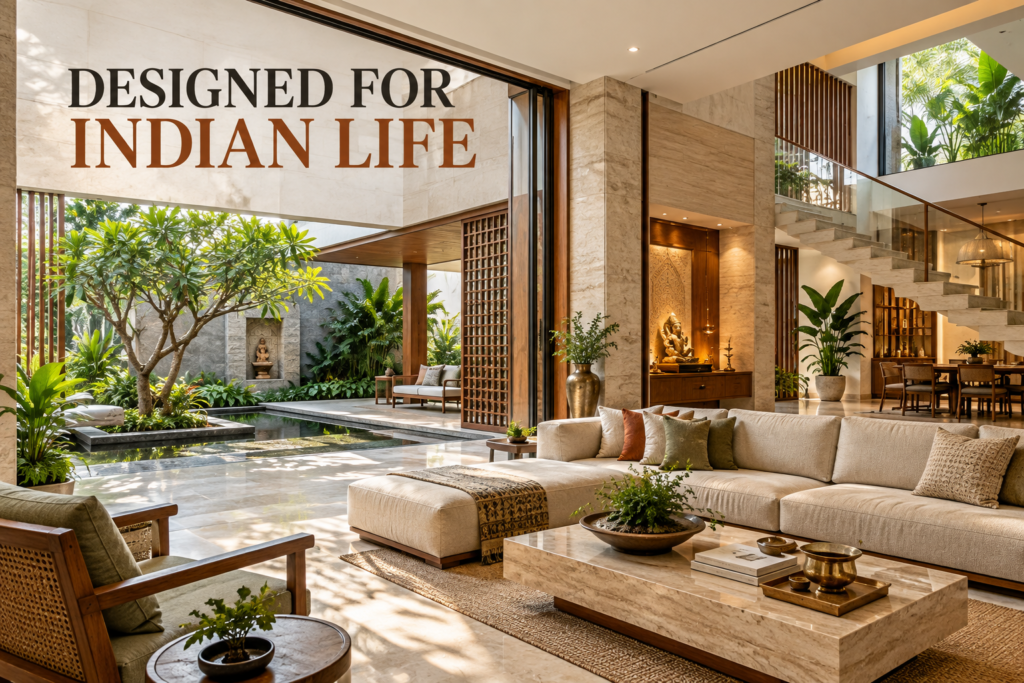
Climate Intelligence Is Essential in India
A luxury home in India cannot be designed as if it exists in a perfect climate.
Indian homes face real conditions.
Summer heat.
Dust.
Monsoon humidity.
Winter chill.
Strong daylight.
Pollution.
Outdoor-indoor transitions.
Material ageing.
A home in Delhi NCR does not need the same design intelligence as a coastal home in Mumbai or a hill home in Himachal.
This is why luxury home design India must be climate-aware.
Livspace’s 2026 India interiors report says homes are moving toward designs that feel good, work well, and age intelligently, with climate awareness, emotional design, craft revival, natural materials, energy efficiency, smart home systems, passive cooling, lime plaster walls, stone floors, and cross-ventilation becoming important considerations.
This is the correct direction.
Luxury interiors should not only look beautiful in photographs.
They should survive heat, humidity, dust, monsoon, and years of use.
A fragile luxury home is not truly luxurious.
Culture Is Not Decoration
Indian luxury cannot simply copy global minimalism.
A luxury Indian home carries cultural life.
Pooja rituals.
Festivals.
Guest hospitality.
Multigenerational families.
Food traditions.
Family gatherings.
Storage for occasion wear.
Sacred spaces.
Vastu preferences where relevant.
Staff-supported living.
Indoor-outdoor hosting.
If a home ignores these realities, it may look international but feel emotionally incomplete.
A pooja room is not just a decorative mandir.
It is a spiritual anchor.
A guest suite is not just a spare bedroom.
It is hospitality architecture.
A kitchen is not just a show kitchen.
It must support Indian cooking, service, storage, and hosting.
A utility room is not a back-end corner.
It protects the visible home from daily work.
Indian luxury does not need to become louder.
It needs to become deeper.
Culture should be integrated with restraint, not applied as theme.
Technology Should Disappear Into Ease
Smart homes are no longer impressive simply because they have more gadgets.
Visible panels, glowing screens, voice commands, motorised curtains, and app-based controls can feel advanced for a moment.
But the real test is daily ease.
Does the lighting shift naturally?
Does the climate stay comfortable?
Does security feel discreet?
Does the system work for elders?
Can staff use what they need without accessing everything?
Does the home still work when Wi-Fi fails?
Is privacy protected?
Can systems be maintained?
Godrej Properties’ luxury buyer research preview describes a shift away from excess and toward calm, wellness, privacy, and homes that support everyday living.
That applies directly to technology.
The best smart home is not the one that shows off intelligence.
It is the one that quietly removes friction from life.
Materials Need Discipline
Luxury materials do not automatically create a luxury home.
Marble can look cold.
Wood can look heavy.
Brass can look loud.
Stone can look flat.
Wallpaper can look dated.
Glass can feel exposed.
A material becomes luxurious only when it is selected, detailed, lit, and maintained intelligently.
This is where many expensive homes fail.
They use too many materials.
Marble here.
Veneer there.
Fluting somewhere else.
Metal strips.
Backlit panels.
Wallpaper.
Mirrors.
Different stones.
Different textures.
The result is costly, but restless.
Luxury does not come from the number of premium finishes.
It comes from restraint.
The best luxury interiors use fewer decisions with more conviction.
Material drenching, wall architecture, layered lighting, and craft-led customisation all belong to this new direction.
The home should not look assembled.
It should feel composed.
Service Flow Is a Luxury Issue
This is one of the most ignored parts of luxury home design.
A home may look beautiful, but if service flow is weak, daily life becomes uncomfortable.
Staff movement becomes visible.
Laundry enters bedrooms.
Cleaning tools appear in corners.
Kitchen work spills into formal areas.
Deliveries disturb the family.
Guests see back-end movement.
Utility work happens in corridors.
A refined Indian luxury home must plan:
- staff circulation
- service entries
- utility rooms
- back kitchens
- laundry flow
- storage systems
- delivery handling
- housekeeping access
- waste management
- outdoor kitchen service
- guest hosting flow
This is not about hiding people.
It is about giving work a dignified, efficient system.
The visible calm of a luxury home is usually protected by invisible planning.
Storage Is Not a Cupboard Problem
Storage is another area where luxury homes often fail.
Many homes have many wardrobes, cabinets, and shelves, but still feel cluttered.
Why?
Because storage is not only about quantity.
It is about placement, access, frequency of use, categorisation, and lifestyle.
A serious luxury home needs storage for:
- daily objects
- shoes
- bags
- keys
- linen
- luggage
- festive décor
- pooja items
- crockery
- cleaning supplies
- children’s items
- guest supplies
- seasonal clothing
- maintenance materials
- outdoor cushions
- documents
- appliances
Luxury storage in India is abundance management.
It does not erase the richness of Indian family life.
It organises it.
The Kitchen Has Become a Lifestyle System
The luxury kitchen is no longer only a cooking space.
It is now connected to:
- family life
- hosting
- pantry storage
- back kitchen
- staff movement
- breakfast routines
- service access
- outdoor kitchen
- appliance planning
- dining experience
- material maintenance
In Indian homes, one open show kitchen is often not enough.
Many luxury homes need layered kitchen planning.
A front kitchen for interaction.
A back kitchen for serious cooking.
A pantry for storage.
A utility connection for cleaning.
An outdoor kitchen for hosting.
The kitchen is not just a room.
It is a lifestyle and service system.
Bathrooms Are Becoming Recovery Spaces
Luxury bathrooms are also changing.
They are no longer judged only by marble, fittings, and size.
They are judged by how they support:
- privacy
- grooming
- storage
- lighting
- ventilation
- water pressure
- drainage
- safety
- maintenance
- relaxation
- daily recovery
A bathroom that looks expensive but feels damp, harsh, slippery, or difficult to clean is not luxurious.
The new luxury bathroom is closer to a private wellness suite.
It supports both routine and restoration.
Outdoor Living Needs Real Planning
Outdoor luxury is no longer only a lawn, terrace, or pool.
Outdoor rooms, outdoor kitchens, shaded courtyards, terraces, gardens, and pool decks are becoming important lifestyle zones.
But outdoor spaces need serious planning in India.
Shade.
Dust control.
Drainage.
Privacy.
Lighting.
Material durability.
Weather protection.
Storage.
Service access.
Monsoon readiness.
An outdoor kitchen is not a barbeque counter.
A terrace is not just an open slab.
A garden is not just landscape.
Outdoor living works only when climate, hosting, service, and comfort are planned together.
The Home Must Support Time
Time is one of the deepest luxuries.
A well-designed home saves time every day.
The entryway prevents arrival chaos.
The wardrobe makes dressing easier.
The bathroom improves morning routines.
The kitchen supports service.
The utility room manages laundry.
Lighting scenes reduce daily adjustment.
Storage prevents searching.
Smart systems simplify control.
Staff circulation prevents interruptions.
A poorly planned home wastes time through small frictions.
Searching.
Moving.
Adjusting.
Correcting.
Cleaning.
Explaining.
Coordinating.
A luxury home should not create daily friction.
It should quietly remove it.
Craft Makes Luxury Personal
Craft-led customisation is becoming more important because fast décor has made many premium homes look similar.
A truly refined home is not assembled from catalogue luxury.
It is shaped around the family.
Custom furniture.
Built-in storage.
Hand-finished walls.
Craft details.
Material junctions.
Tailored seating.
Personal libraries.
Pooja spaces.
Bespoke wardrobes.
Custom vanities.
Craft does not mean adding ornament everywhere.
It means material knowledge, detailing, proportion, touch, and longevity.
The new Indian luxury home is not trying to look handmade everywhere.
It is trying to feel considered everywhere.
Delhi NCR Luxury Homes Need Architect-Led Thinking
This is especially important in Delhi NCR.
Homes here often deal with:
- plot constraints
- builder floors
- farmhouses
- basements
- multi-level planning
- parking
- privacy
- heat
- dust
- monsoon
- staff movement
- terrace use
- neighbouring buildings
- authority requirements
- service coordination
- premium client expectations
A Delhi NCR luxury home is rarely just an interior styling project.
It usually needs architecture, interiors, civil work, MEP, lighting, automation, procurement, furniture, landscape, and execution to work together.
That is why residential architects Delhi NCR and the best architects in Delhi must think beyond appearance.
And why the best interior designers in Delhi must understand planning, services, execution, and long-term ownership.
A luxury home is not a collection of beautiful rooms.
It is an integrated living system.
Design-Build Accountability Ties Everything Together
As homes become more complex, accountability becomes more valuable.
A luxury home fails when architecture, interiors, construction, MEP, lighting, automation, furniture, and finishing are treated as separate islands.
The client should not become the person coordinating everyone else’s mistakes.
Design-build accountability matters because it creates one integrated system.
One vision.
One chain of responsibility.
One coordinated process.
This is especially important in luxury home design India, where high-end homes involve complex services, custom details, climate conditions, cultural requirements, staff flow, and multiple vendors.
The true luxury is not only the finished home.
It is confidence in the system that delivers it.
What Defines Luxury Home Design in India Today?
The new Indian luxury home is defined by:
1. Intelligent Planning
The home works before it impresses.
2. Privacy
The home knows what to reveal and what to protect.
3. Wellness
Comfort, air, light, sound, sleep, and recovery are planned into daily life.
4. Climate Response
The home understands heat, dust, monsoon, winter, daylight, and material ageing.
5. Cultural Grounding
Pooja, hospitality, festivals, family life, and Indian rituals are designed with dignity.
6. Service Intelligence
Staff movement, utility work, laundry, deliveries, storage, and maintenance are planned properly.
7. Invisible Technology
Smart systems improve life without turning the home into a gadget showroom.
8. Material Restraint
Materials are selected, detailed, lit, and maintained with discipline.
9. Craft-Led Customisation
The home feels made for one family, not assembled from generic luxury references.
10. Design-Build Accountability
The vision is protected from concept to handover through one coordinated system.
The New Definition of Luxury
Luxury is no longer only about what people see.
It is also about what they never have to worry about.
The guest who arrives comfortably.
The family that has privacy.
The staff who can work efficiently.
The kitchen that supports hosting.
The bathroom that restores.
The wardrobe that saves time.
The lighting that shifts with mood.
The storage that prevents clutter.
The technology that disappears.
The materials that age well.
The home that feels calm through every season.
This is the new luxury.
Not visible expense.
Intelligent living.
Conclusion
Luxury home design in India is entering a more mature phase.
The finest homes are no longer defined only by size, marble, chandeliers, imported brands, or decorative drama.
They are defined by planning.
Privacy.
Wellness.
Climate intelligence.
Culture.
Craft.
Technology.
Service flow.
Material restraint.
Maintenance.
Accountability.
A home may look expensive on the first day.
But a true luxury home proves itself every day after that.
In how it receives people.
How it protects the family.
How it supports routines.
How it handles weather.
How it ages.
How it reduces friction.
How it feels personal.
How it remains calm.
That is the future of luxury home design in India.
Not more visible expense.
More intelligent living.