

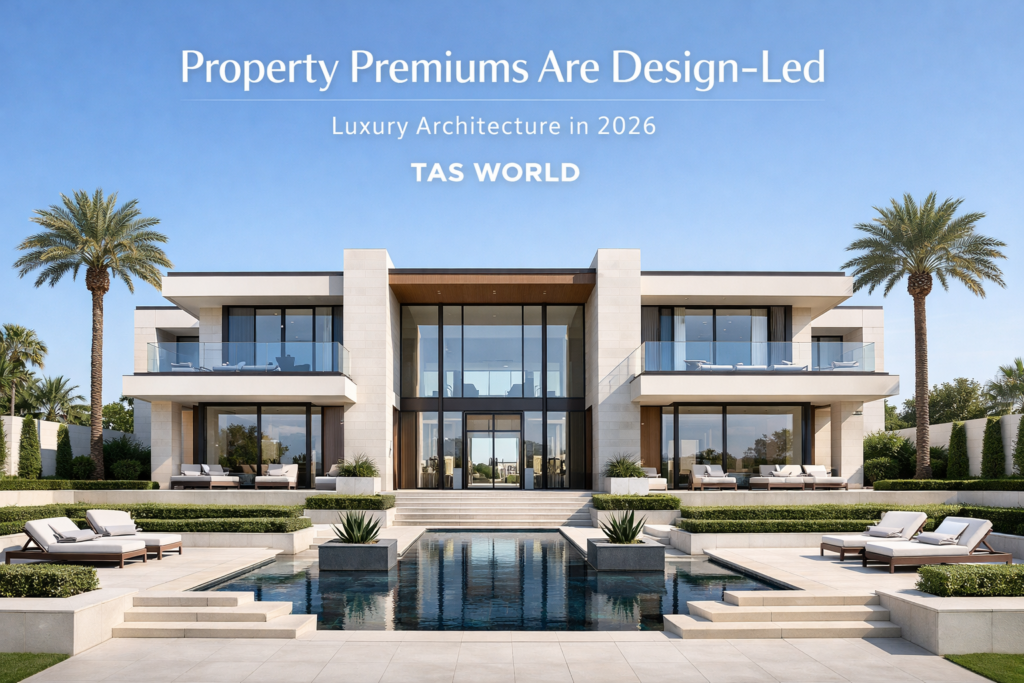
In 2026, luxury real estate is no longer defined by location alone.
Prime address still matters. Plot size still matters. But in competitive high-end markets like Delhi NCR, those factors are no longer enough to justify premium pricing.
Architecture has become the differentiator.
Homes that command higher valuations today are not simply larger or more expensive to build. They are strategically designed. They feel intentional, resilient, and future-ready.
Design is no longer cosmetic.
It is financial leverage.
The Shift: From Location-Led to Design-Led Value
Two properties in the same neighborhood can perform very differently in the market.
One sells quickly at a premium.
The other negotiates downward despite similar land value.
The difference is rarely random.
Luxury residential architecture now influences:
Buyer perception
Market positioning
Resale demand
Long-term appreciation
Architecture has become a brand identity for the property itself.
Architecture as Asset Branding
A home with a strong architectural identity stands out immediately.
Controlled arrival sequence
Clear façade geometry
Balanced proportions
Material coherence
These elements create memorability.
In high-end markets, memorability translates into demand. Demand influences price resilience.
Luxury real estate architecture firms in India increasingly understand that a villa must express identity, not imitation.
Distinct architecture reduces market competition.
Performance-Driven Premiums
Today’s buyers are more informed.
They ask about:
Energy efficiency
Heat control
Acoustic comfort
Waterproofing resilience
Long-term maintenance
Homes designed with climate intelligence and integrated façade systems outperform visually similar properties built without technical foresight.
Ventilated façades reduce cooling load.
Layered waterproofing protects structural integrity.
Acoustic zoning enhances livability.
Performance becomes a hidden valuation factor.
In Delhi NCR’s extreme climate, durability protects capital.
Spatial Intelligence and Market Appeal
Square footage alone does not define value.
Flow defines value.
Homes that feel expansive, even within compact plots, command higher emotional response.
Double-height voids
Courtyard planning
Layered zoning
Controlled compression and expansion
These spatial strategies influence how buyers perceive scale.
Luxury villa architects in India increasingly focus on experiential scale rather than numeric area.
When space feels deliberate, it feels expensive.
Emotional Architecture and Buyer Psychology
Real estate transactions are not purely rational.
They are emotional decisions supported by rational justifications.
Memory influences pricing power.
A home that creates:
A powerful arrival sequence
A dramatic reveal
Calm interior silence
Layered outdoor living
Is remembered differently.
Emotion drives perceived value.
Luxury architecture firms in Delhi are now competing on experiential depth, not just material cost.
Execution Quality and Risk Perception
Buyers in 2026 are increasingly cautious.
They evaluate build quality carefully.
Visible construction flaws, poor detailing, or long-term maintenance risks reduce confidence.
Integrated design-build execution protects:
Structural precision
Waterproofing integrity
Mechanical coordination
Material longevity
When architecture and construction are aligned from concept stage, asset risk decreases.
Lower perceived risk supports higher valuation.
Lifecycle Thinking and Investor Confidence
Luxury real estate is no longer a short-term transaction for many buyers.
It is generational capital.
Homes designed with:
Energy efficiency
Low maintenance materials
Climate resilience
Adaptable spatial planning
Maintain relevance over decades.
Design-led properties age better.
Longevity is value stability.
Why Location Alone Is No Longer Enough
Two villas on identical plots can diverge dramatically in market performance.
One may rely on façade ornamentation.
The other integrates spatial intelligence, performance engineering, and disciplined materiality.
The latter commands stronger resale confidence.
In Delhi NCR’s evolving luxury segment, architecture increasingly determines:
Price justification
Buyer urgency
Market differentiation
Location sets the baseline.
Design sets the premium.
The 2026 Luxury Buyer Mindset
Today’s high-net-worth buyer evaluates homes differently.
They look beyond marble finishes.
They ask:
How does this home handle heat?
Is it acoustically calm?
Will it age well?
Is the spatial layout future-proof?
Does it feel intentional?
Luxury residential architecture now intersects directly with investment logic.
Design decisions influence asset resilience.
Architecture as Financial Strategy
In 2026, design-led real estate is not theory.
It is market reality.
Architecture drives:
Perception
Performance
Longevity
Differentiation
Confidence
Luxury homes that integrate climate intelligence, spatial narrative, structural discipline, and experiential planning consistently outperform in valuation.
Architecture is no longer an expense layered onto land.
It is the multiplier.