

Luxury interiors used to be judged by how many premium materials they displayed.
Marble.
Veneer.
Metal.
Glass.
Leather.
Wallpaper.
Stone.
Fabric.
Decorative panels.
The assumption was simple.
More expensive materials meant more luxury.
But that idea is changing.
The most refined luxury homes are no longer trying to make every surface compete for attention. They are moving toward a more disciplined design language, where one dominant material is allowed to create atmosphere, continuity, and depth.
This is why material drenching is becoming the new luxury design language.
Not because it uses more material.
Because it uses material with more intelligence.
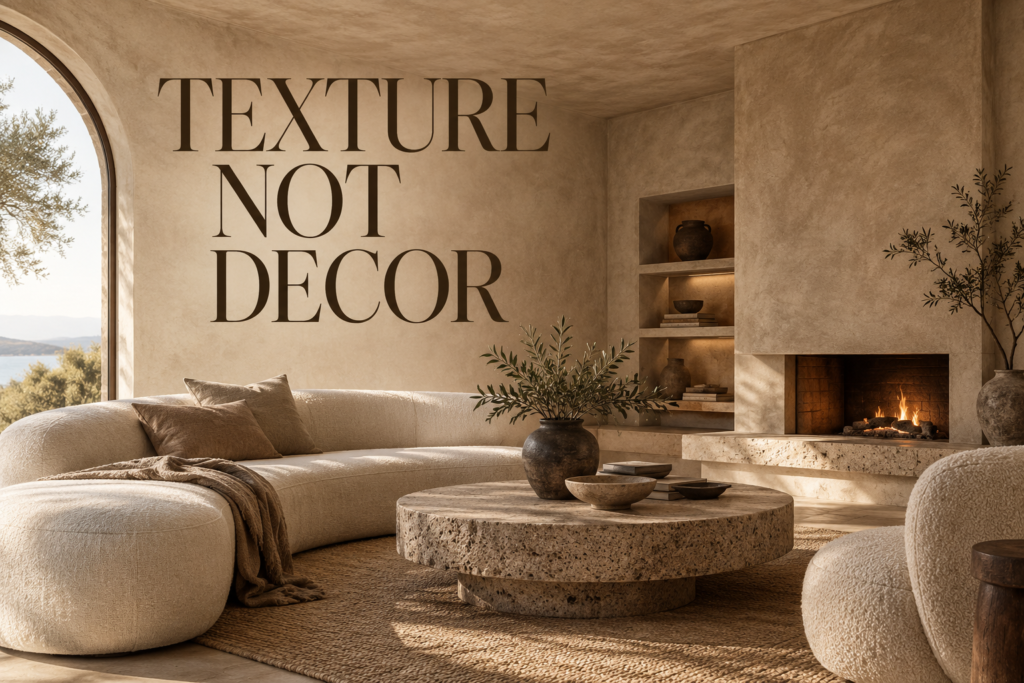
What Is Material Drenching?
Material drenching is the use of one dominant material across multiple surfaces in a space.
It may be stone.
Wood.
Tile.
Lime plaster.
Fabric.
Metal.
Leather.
Microcement.
Textured wall finish.
Instead of using one material on one feature wall and another material somewhere else, the room is wrapped in a more continuous language.
A powder room may be drenched in one stone.
A lounge may be wrapped in warm wood.
A bedroom may use lime plaster across walls and ceiling.
A bathroom may carry one tile language across walls, floor, and niches.
A wardrobe may use one timber tone across cabinets, island, and wall panels.
The result is immersive.
The space does not feel assembled from separate decorative decisions.
It feels composed.
Material Drenching Is Not Material Overuse
This distinction matters.
Material drenching is not blindly covering everything with marble.
It is not using wood everywhere without proportion.
It is not making a room heavy.
It is not adding luxury finishes for the sake of visible cost.
The best material drenching is controlled.
It is about continuity, not excess.
It lets one material become the atmosphere of the room.
That is why it can feel more luxurious than a room with ten expensive materials competing against each other.
Luxury weakens when every surface tries to prove itself.
Material drenching works because it removes that competition.
Why This Trend Is Rising Now
Current luxury interiors are moving away from flat, sterile minimalism.
Homeowners want rooms that feel warmer, more tactile, more personal, and more emotionally grounded.
Recent India-focused interior trend coverage notes that quiet luxury is maturing beyond plain neutrals and minimalism, with 2026 interiors leaning toward texture, authenticity, organic textiles, low-VOC paints, reclaimed wood, bamboo, jute, cane, natural woods, warm whites, and sculptural décor objects.
This is important.
Luxury is no longer only about polished surfaces.
It is about depth.
Texture.
Craft.
Warmth.
Material honesty.
Material drenching fits this shift because it creates rooms that feel complete, not decorated.
A Reaction Against Scattered Luxury
Many expensive homes do not feel truly refined.
Not because they lack budget.
Because they lack restraint.
One wall has marble.
Another has veneer.
The ceiling has grooves.
The TV wall has backlit stone.
The bar has metal strips.
The passage has wallpaper.
The bedroom has fluted panels.
The bathroom has three tile types.
The result may be costly.
But it is not calm.
This is scattered luxury.
Every surface is trying to announce value.
Material drenching offers the opposite.
It says:
Choose one material well.
Use it with discipline.
Let it breathe.
Let the room feel whole.
That is a more mature form of luxury.
Continuity Creates Calm
The eye relaxes when a room has continuity.
When the floor, wall, niche, ceiling, cabinetry, or built-in elements share one material language, the room feels more settled.
There is less visual interruption.
Less unnecessary contrast.
Less decorative noise.
More depth.
More atmosphere.
More architectural clarity.
This is especially powerful in high-end homes because luxury clients often want calm, but unknowingly approve too many competing details.
A room does not become rich because every surface is different.
It becomes rich when every surface belongs.
One Material Can Feel Richer Than Ten
This is one of the most important lessons in luxury interior design.
A single material, used beautifully, can feel richer than a crowded palette.
A travertine powder room with soft lighting can feel more luxurious than a bathroom with five finishes.
A warm wood library can feel deeper than a room with multiple wallpapers and panels.
A lime-plaster bedroom can feel calmer than a heavily decorated bedroom.
A microcement bathroom can feel more contemporary than a space filled with disconnected tiles.
A brass-accented bar can feel more powerful when the metal is restrained and repeated with precision.
Luxury is not the number of materials.
Luxury is the quality of control.
Material Drenching Needs Architecture
Material drenching fails when it is treated as styling.
It needs architectural thinking.
Where does the material begin?
Where does it stop?
Does it wrap corners cleanly?
Does the flooring meet the wall with discipline?
Do niches align?
Do lights reveal the surface correctly?
Are joints visible or concealed?
Is the material appropriate for the room’s function?
Can it handle moisture, heat, dust, touch, cleaning, and time?
This is why material drenching is not an interior shortcut.
It requires more coordination, not less.
The more continuous the material, the less it can hide mistakes.
Poor joints become visible.
Poor lighting becomes obvious.
Poor proportions feel heavy.
Poor material selection becomes expensive to maintain.
A drenched room must be designed properly from the beginning.
Light Makes Material Drenching Work
Material drenching is deeply dependent on lighting.
Stone needs grazing light to reveal texture.
Wood needs warm light to bring out grain.
Lime plaster needs shadow to show depth.
Metal needs controlled reflection.
Tile needs rhythm and scale.
Fabric needs soft light.
Microcement needs evenness.
Without lighting, material drenching can feel flat or heavy.
This is why layered lighting and material design must be planned together.
A material-drenched room should not simply be bright.
It should be lit to reveal the material’s character.
The light should make the surface feel alive.
Not glossy for the sake of drama.
Not harsh.
Not showroom-like.
Just enough to reveal depth.
Material Drenching Works Beautifully in Small Rooms
Small rooms often benefit most from material drenching.
Because their scale is controlled.
Powder rooms.
Bathrooms.
Walk-in wardrobes.
Bars.
Private lounges.
Mandirs.
Reading rooms.
Guest bathrooms.
Home offices.
These rooms can carry a strong material identity without overwhelming the entire home.
A powder room wrapped in stone can feel jewel-like.
A wardrobe wrapped in timber can feel intimate.
A pooja room in warm stone and brass can feel sacred.
A bar in dark wood and metal can feel atmospheric.
A bathroom in one tile language can feel calm and seamless.
Material drenching gives small rooms presence.
Without needing clutter.
It Can Also Work in Large Rooms, But With More Discipline
In larger spaces, material drenching becomes more complex.
A large living room fully wrapped in one material can feel powerful.
But it can also become monotonous or heavy if not handled carefully.
Large rooms need variation inside continuity.
This can come through:
- different surface finishes of the same material
- texture changes
- lighting changes
- soft furniture contrast
- rugs
- artwork
- openings
- greenery
- built-in forms
- shadow gaps
- natural light
The material stays dominant.
But the room still breathes.
This is the key.
Material drenching should create immersion, not suffocation.
Indian Luxury Homes Need Material Discipline
In India, many luxury interiors suffer from over-treatment.
Too many panels.
Too many grooves.
Too much marble.
Too much brass.
Too many backlit surfaces.
Too many textures.
Too many patterns.
Too many “features.”
This often comes from good intent.
Clients want the home to feel premium.
Designers want to show work.
Vendors want to sell finishes.
But the result can become visually restless.
The next stage of luxury interior design India is not more material.
It is more material discipline.
The best architects in Delhi and best interior designers in Delhi should not ask how many luxury finishes can be added.
They should ask which material deserves to lead.
Material Drenching and Indian Craft
Material drenching also creates an opportunity for craft.
A room can be drenched in hand-finished lime plaster.
Or natural stone.
Or timber.
Or handmade tile.
Or brass.
Or cane and wood detailing.
Or textured plaster.
Or microcement.
When done well, the material is not just a surface.
It becomes the room’s identity.
This aligns strongly with the shift toward authenticity and craft-led interiors.
A crafted material has memory.
It shows human touch.
It ages with more dignity than synthetic surface drama.
In luxury homes, material should not only look expensive.
It should feel considered.
Maintenance Decides Whether It Is Truly Luxury
This is the part most trend articles ignore.
Material drenching can be beautiful.
But the wrong material in the wrong place creates long-term problems.
Wood in a damp bathroom.
Marble in a high-stain area.
Metal near hard water.
Fabric in a dusty passage.
Delicate plaster in high-touch zones.
Glossy tile in slippery wet areas.
Porous stone without sealing.
Leather in harsh sunlight.
If a room is drenched in a material, that material must be suitable for the room’s reality.
Luxury is not only what looks beautiful on handover day.
Luxury is what survives daily use.
This is especially important in Indian homes, where dust, humidity, heat, monsoon, hard water, cleaning cycles, and staff maintenance all affect materials.
A truly refined material palette is not only beautiful.
It is intelligent.
Material Drenching Should Match the Room’s Function
Different rooms need different material logic.
Bathrooms
Stone, tile, microcement, or waterproof plaster can create a strong immersive effect, but slip resistance, drainage, sealing, cleaning, and hard-water behaviour must be studied.
Powder Rooms
These are ideal for expressive material drenching because they are small, controlled, and guest-facing.
Bedrooms
Soft plaster, fabric walling, timber, or warm textures can create calm, but acoustics, dust, and maintenance must be considered.
Walk-In Wardrobes
Wood, leather, fabric panels, or textured finishes can create warmth, but lighting, humidity, garment care, and security matter.
Pooja Rooms
Stone, wood, brass, and jaali can create sacred presence, but ventilation, incense, diya soot, and ritual storage must be planned.
Bars
Dark wood, metal, stone, or lacquer can create atmosphere, but lighting, spills, glassware, refrigeration, and serviceability matter.
Living Rooms
Material continuity can create grandeur, but large rooms need proportion, relief, lighting, and softness.
Material drenching is not one formula.
It is a design decision that must respond to use.
The Risk of Trend-Chasing
Material drenching is powerful because it can create timeless rooms.
But it can also become another trend if copied blindly.
A room should not be drenched just because the term is fashionable.
The decision must come from the space.
The architecture.
The client.
The material.
The emotion.
The function.
The maintenance reality.
The best luxury interiors do not chase trends.
They absorb useful ideas and make them feel inevitable.
Material drenching works when it feels like the natural language of the room.
Not a forced effect.
The Difference Between Immersive and Overdone
There is a fine line between immersive and overdone.
Immersive means the material creates atmosphere.
Overdone means the material overwhelms the room.
Immersive feels calm.
Overdone feels heavy.
Immersive has restraint.
Overdone has repetition without judgement.
Immersive uses light, proportion, and details.
Overdone just covers surfaces.
This is why material drenching needs taste.
Not just budget.
Why It Feels Expensive
Material drenching feels expensive because it creates resolution.
The room feels intentional.
The surfaces speak one language.
The transitions feel controlled.
The material has presence.
The details feel coordinated.
There is less visual noise.
The space feels designed, not decorated.
This is what serious clients are really buying.
Not just material cost.
They are buying confidence.
The feeling that every decision belongs.
What Smarter Luxury Homes Do Differently
1. They Choose One Material to Lead
They do not allow every surface to compete.
One material carries the room’s identity.
2. They Use Continuity With Restraint
The material flows across surfaces, but the room still has proportion, relief, and breathing space.
3. They Plan Lighting Early
Light is used to reveal texture, grain, depth, and shadow without glare.
4. They Respect Maintenance
The selected material must handle the room’s water, dust, heat, touch, cleaning, and usage.
5. They Avoid Copy-Paste Luxury
The material choice comes from the home’s architecture and the family’s lifestyle, not from trend images.
6. They Use Craft Carefully
Hand-finished surfaces, natural materials, and bespoke details are used where they add depth, not noise.
7. They Know When to Stop
The best material-drenched rooms are powerful because they are edited.
The New Definition of Luxury Materials
A luxury material is not luxurious only because it is expensive.
It becomes luxurious when it is used with intelligence.
Where it is placed.
How it is detailed.
How it is lit.
How it ages.
How it feels.
How it supports the room.
How much space it is given to speak.
Material drenching is valuable because it gives material that space.
It lets stone feel architectural.
Wood feel enveloping.
Plaster feel atmospheric.
Tile feel immersive.
Metal feel precise.
Fabric feel intimate.
This is where material becomes more than finish.
It becomes experience.
Conclusion
Material drenching is becoming the new luxury design language because refined homes are moving away from scattered decoration and toward immersive material clarity.
The future of luxury interiors is not about using more finishes.
It is about using fewer decisions with more conviction.
A room does not need every surface to be different.
It needs every surface to belong.
That is what material drenching can achieve when it is done well.
Continuity.
Depth.
Calm.
Texture.
Identity.
Presence.
But only when it is supported by proportion, lighting, maintenance intelligence, craftsmanship, and restraint.
Because true luxury is not the display of many expensive materials.
It is the discipline to let one material become unforgettable.