

Luxury homes are often designed as if nobody will ever spill anything, scratch anything, run anywhere, drag a school bag through the foyer, leave toys in the living room, bring muddy paws in from the garden, or touch a wall with wet hands.
They are photographed at their most perfect moment.
No pets. No children. No guests. No school bags. No feeding bowls. No sports shoes. No leashes. No crayons. No laundry. No daily life.
But real homes do not stay inside photographs.
They are lived in.
Children grow inside them. Pets move through them. Families host inside them. Staff clean and maintain them. Guests arrive. Shoes come in. Outdoor spaces get used. Furniture is touched. Floors are walked on. Walls are leaned against. Life leaves evidence.
That is why pet and child-friendly planning is becoming essential in luxury homes.
Not because luxury homes should become casual.
Not because elegance should be compromised.
Because a truly refined home should be intelligent enough to welcome real family life without becoming fragile.
A home is not truly luxurious if the family has to constantly protect the home from the way they actually live.
Family-Friendly Luxury Homes Are Not a Compromise
The phrase family-friendly luxury homes is often misunderstood.
Many people imagine a softer, less refined version of luxury. More washable. More practical. Less beautiful. Less formal. Less premium.
That is the wrong way to think about it.
Family-friendly luxury is not a downgrade.
It is a higher planning standard.
It asks more from the home.
The home must be beautiful, but also durable. Elegant, but also safe. Refined, but also washable. Personal, but also organised. Premium, but also forgiving.
The best luxury homes are not the ones protected from children and pets.
They are the ones designed intelligently enough to include them.
Luxury Buyers Are Moving Toward Real-Life Living
The market direction is already visible.
Godrej Properties’ luxury buyer preview, The Elevated Living Edit, reported that more than 60% of buyers favour dedicated pet lifts, while 84% prefer private balconies and wellness-led living is becoming a stronger expectation among premium buyers.
Hindustan Times also reported the same luxury buyer signals, noting that high-end homebuyers increasingly prefer private balconies, wellness spaces, and dedicated pet lift features.
These details matter because they show a deeper shift.
Luxury buyers are no longer thinking only about marble, height, amenities, and grandeur.
They are thinking about how the home supports actual life.
Pets. Children. Privacy. Outdoor access. Wellness. Convenience. Safety. Ease.
This is the next luxury standard.
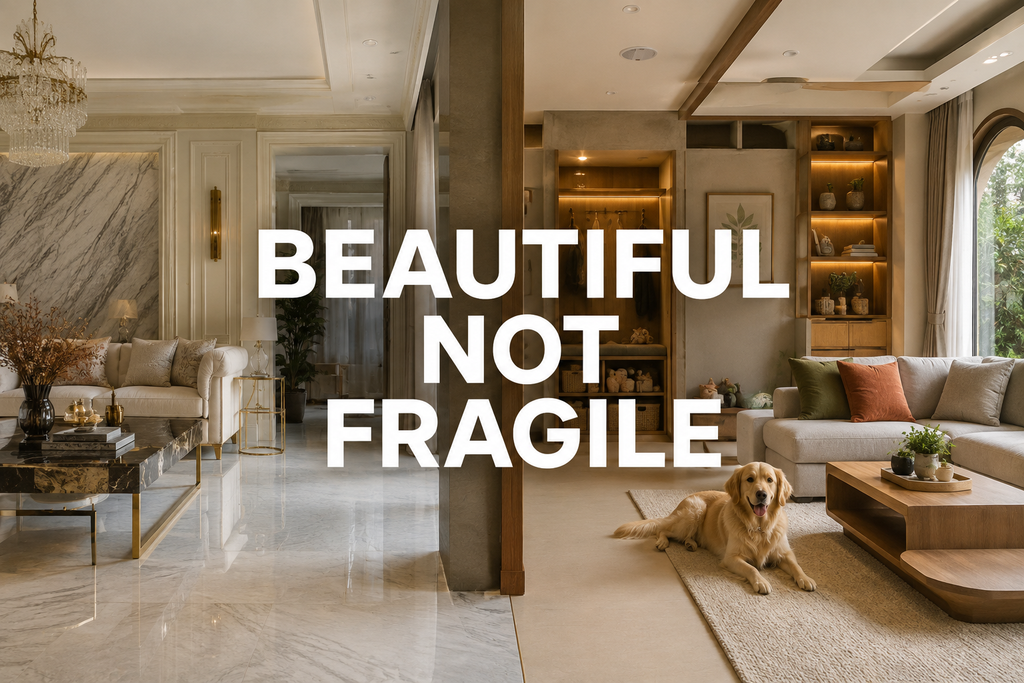
Beautiful Homes Should Not Be Fragile
Fragile luxury creates anxiety.
Nobody can sit comfortably.
Children are constantly corrected.
Pets are restricted from rooms.
Guests are warned about surfaces.
Staff are afraid of cleaning delicate finishes.
The family lives around the home instead of living inside it.
That is not luxury.
A luxury home should create ease.
It should allow the family to enjoy beauty without treating every room like a museum.
The answer is not to avoid premium materials.
The answer is to select, detail, protect, and place materials intelligently.
Pet and Child-Friendly Planning Starts Before Interior Styling
Most people think pet and child-friendly design starts with fabrics.
Performance upholstery. Washable rugs. Durable flooring.
Those matter.
But they are only one layer.
Real planning begins much earlier.
It includes circulation, safety, storage, stairs, railings, balconies, outdoor access, utility rooms, cleaning routes, material behaviour, hygiene, acoustic comfort, ventilation, and long-term maintenance.
A child-friendly interior design strategy cannot be added after the layout is weak.
A pet-friendly home design strategy cannot be solved only by buying a dog bed.
The architecture must support the life inside the home.
Flooring Is the First Real-Life Test
Floors carry the truth of a home.
Children run on them.
Pets walk, scratch, slip, and shed on them.
Shoes bring dust.
Outdoor spaces bring mud.
Toys fall.
Food spills.
Water drops.
A beautiful floor that is slippery, cold, easily stained, or stressful to maintain can weaken daily life.
Pet-friendly home guidance often places strong emphasis on non-slip flooring, durable finishes, safe movement, pet gates, and awareness that some plants and flowers can be toxic to pets.
For luxury homes, the flooring decision should consider:
– slip resistance
– scratch resistance
– stain behaviour
– cleaning method
– comfort underfoot
– acoustic softness
– indoor-outdoor movement
– ageing and repairability
– safety for children and elders
Glossy stone may photograph beautifully, but it may not be ideal everywhere.
A more honed finish, textured stone, engineered timber, selected tiles, or durable surface may perform better depending on the zone.
Luxury is not the floor that looks perfect once.
It is the floor that remains graceful after years of movement.
Corners, Edges, and Heights Matter
Child-friendly luxury is often decided by small details.
The edge of a coffee table.
The height of a console.
The sharpness of a stone corner.
The placement of a glass object.
The stair railing gap.
The balcony detail.
The height of a window ledge.
The accessibility of switches.
The visibility from kitchen to play area.
The safety of loose rugs.
These details do not make the home less luxurious.
They make the home more intelligent.
Rounded furniture edges, softened stone details, safer railing design, stable rugs, better storage heights, and clear circulation can protect the family while preserving elegance.
Balconies and Terraces Need Safety Logic
Private balconies are becoming a major luxury preference, but balconies and terraces are also high-responsibility zones when children and pets are involved.
The Godrej buyer preview reported that 84% of homebuyers prefer private balconies, and this preference aligns with a broader desire for indoor-outdoor living.
But outdoor access must be designed carefully.
A family-friendly luxury home should consider:
– railing height
– railing gaps
– anti-skid flooring
– planter placement
– pet-safe plants
– terrace boundaries
– outdoor lighting
– shaded sitting areas
– storage for cushions and toys
– supervision-friendly sightlines
– controlled access to risky zones
A terrace should not become dangerous because it was treated as a styling zone.
Outdoor luxury needs safety, privacy, climate, drainage, and maintenance planning.
Storage Protects Family Luxury
Children and pets come with objects.
School bags.
Toys.
Books.
Sports gear.
Art supplies.
Leashes.
Pet food.
Pet towels.
Grooming tools.
Medication.
Outdoor shoes.
Rainwear.
Cleaning supplies.
If these objects do not have a place, they take over the home.
A luxury home does not stay refined because life is minimal.
It stays refined because life is organised.
This is why storage architecture becomes essential.
A family-friendly luxury home should include:
– entryway storage
– toy storage
– pet supply storage
– school bag zones
– utility storage
– outdoor gear storage
– cleaning supply cabinets
– washable linen storage
– concealed family clutter zones
The goal is not to erase family life.
The goal is to give family life a system.
Entryways Become More Important
The entryway is the first filter between the outside world and the home.
For families with children and pets, this zone becomes even more important.
It handles shoes, bags, dust, pet leashes, muddy paws, rainwear, sports gear, parcels, and outdoor movement.
A weak entryway allows disorder to spread.
A strong entryway contains it.
A pet and child-friendly entryway may need:
– shoe storage
– bench seating
– washable flooring
– hooks for bags and leashes
– concealed storage
– pet towel drawer
– school bag drop zone
– umbrella and rainwear storage
– durable wall finish
– easy access to utility or wash areas
This is not casual design.
It is discipline at the threshold.
Utility Rooms Become the Hidden Backbone
Children and pets increase laundry, cleaning, drying, and maintenance needs.
More towels.
More washable covers.
More uniforms.
More pet bedding.
More cleaning cycles.
More rainy-day management.
More outdoor-to-indoor transition work.
Without a utility room, this work enters visible spaces.
Balconies become drying zones.
Bathrooms become cleaning stations.
Bedrooms collect laundry.
Kitchens hold household supplies.
A serious luxury home needs utility planning.
For family-friendly luxury homes, the utility room may support:
– laundry
– drying
– ironing
– pet laundry
– cleaning supplies
– washable covers
– outdoor cushion storage
– rainwear
– staff work
– maintenance supplies
The visible luxury of the home is protected by invisible domestic infrastructure.
Pet Zones Should Be Designed, Not Improvised
A pet bed randomly placed in a corner is not pet-friendly planning.
A luxury home with pets should think through feeding, sleeping, grooming, outdoor access, cleaning, storage, and movement.
This may include:
– dedicated feeding zone
– washable wall backing near bowls
– pet bed integrated into cabinetry or a quiet corner
– pet shower or wash point where appropriate
– storage for food and grooming products
– safe access to garden or balcony
– non-slip flooring
– movement gates where needed
– pet-safe plants
– ventilation and odour control
Pet-friendly design should not make the home look like a kennel.
It should make pet life feel naturally integrated into the home.
Children’s Spaces Must Evolve
Children grow quickly.
A nursery becomes a playroom.
A playroom becomes a study zone.
A child’s bedroom becomes a teenager’s room.
A family lounge becomes a study, gaming, reading, and gathering area.
This is why child-friendly interior design should not be too theme-heavy or age-locked.
Architectural Digest has noted that designing for children increasingly involves durability, health-aware material choices, and long-term flexibility rather than relying only on synthetic stainproofing treatments or overly temporary design solutions.
A luxury child-friendly room should consider:
– adaptable furniture
– study and play zones
– safe storage
– washable surfaces
– non-toxic materials
– good lighting
– acoustic comfort
– flexible colour strategy
– future conversion potential
The room should support the child now without becoming irrelevant too soon.
Health-Aware Materials Matter
Durability should not come at the cost of health.
This is especially important in spaces used by children and pets.
Some stain-resistant treatments and synthetic materials may raise long-term health and environmental questions. Architectural Digest’s recent coverage on designing for kids pointed to growing concern around stainproof fabrics that rely on PFAS and noted interest in natural durable alternatives.
This does not mean every performance material should be rejected.
It means materials should be selected thoughtfully.
A luxury home should consider:
– low-VOC paints
– safer adhesives
– non-toxic finishes
– washable natural fabrics where practical
– durable but health-conscious upholstery
– easy-clean surfaces
– ventilated installation periods
– formaldehyde-aware cabinetry choices where possible
– materials suitable for children’s rooms and pet zones
A home designed for family life should protect both the material and the people using it.
Acoustics Are Part of Family Comfort
Children and pets bring energy into a home.
Running, playing, barking, music, toys, television, guests, and daily movement can make a home feel noisy if acoustics are ignored.
Luxury homes often use hard materials such as marble, glass, stone, and high ceilings.
These can increase sound reflection.
A family-friendly luxury home needs acoustic softness through:
– rugs
– curtains
– upholstered furniture
– fabric panels
– bookshelves
– acoustic backing where needed
– softer ceiling or wall strategies
– zoning between play and rest areas
A home that looks luxurious but sounds harsh does not feel luxurious for long.
Visibility and Supervision Should Be Designed
Families need different levels of visibility.
Parents may want to see children from the kitchen or family lounge.
Pets may need access to outdoor areas without entering formal spaces.
Staff may need to assist without crossing private zones unnecessarily.
This requires planning.
Open-plan living can help, but too much openness can reduce privacy and increase noise.
The better solution is controlled visibility.
The home should allow supervision where needed and privacy where deserved.
This is where architecture, not decoration, makes the difference.
Staircases and Railings Need Serious Attention
Staircases are beautiful architectural elements, but they are also risk zones.
Children run on them.
Pets may slip on them.
Elders may need support.
Guests may use them during gatherings.
A luxury staircase should consider:
– tread depth
– riser comfort
– anti-slip treatment
– railing height
– railing gaps
– child safety
– pet grip
– step lighting
– handrail comfort
– landing visibility
A staircase can be sculptural and safe.
Those are not opposing goals.
The Home Should Be Easy for Staff to Maintain
Indian luxury homes are often staff-supported.
That means the design must consider how cleaning, laundry, pet care, food service, and daily reset will actually happen.
Staff need clear systems:
– where pet supplies are stored
– where toys are returned
– which cleaners are safe
– which surfaces cannot be scrubbed
– where laundry moves
– how outdoor cushions are stored
– how pet bedding is washed
– how balcony and terrace areas are cleaned
– how children’s rooms are reset
Luxury homes get damaged when maintenance is unclear.
A family-friendly home should be easy to care for, not only easy to photograph.
Formal Rooms and Family Rooms Need Different Rules
Not every room must have the same level of durability.
A formal drawing room may be used differently from a family lounge.
A child’s play area may need different materials from a dining room.
A pet feeding zone needs different surfaces from a pooja room.
A terrace needs different planning from a bedroom.
The mistake is using one design logic everywhere.
A luxury home should classify zones:
– high-use family zones
– formal guest zones
– pet movement zones
– child play zones
– private rest zones
– service and cleaning zones
– outdoor transition zones
Each zone needs its own durability, safety, and maintenance logic.
Delhi NCR Homes Need This Even More
Pet and child-friendly planning is especially relevant in Delhi NCR luxury homes.
Homes here often deal with:
– dust
– heat
– monsoon
– terraces
– builder floors
– farmhouses
– basements
– staff-supported living
– school routines
– outdoor movement
– pets moving between garden and home
– frequent hosting
– high-value finishes
This makes planning more important.
Residential architects Delhi NCR and the best architects in Delhi cannot treat family-friendly design as an afterthought.
The best interior designers in Delhi must also understand durability, safety, cleaning, storage, and climate behaviour, not only aesthetics.
In luxury home design India, real life is not a problem to hide.
It is the brief.
Family-Friendly Does Not Mean Less Elegant
This is the most important point.
Pet and child-friendly luxury does not mean plastic-looking furniture, dull materials, washable everything, and design compromise.
It means selecting better materials.
Planning better routes.
Designing safer edges.
Creating better storage.
Choosing durable fabrics.
Improving entryways.
Adding utility support.
Protecting outdoor access.
Making the home easier to clean.
The visual standard remains high.
The planning standard becomes higher.
Family-friendly luxury is not less luxurious.
It is more complete.
What Smarter Luxury Homes Do Differently
1. They Choose Durable Beauty
They select materials that look refined and survive real use.
2. They Plan Safety Early
Stairs, balconies, railings, corners, floors, and outdoor zones are designed with children and pets in mind.
3. They Build Storage Around Real Life
Toys, bags, pet supplies, sports gear, school items, and cleaning tools have defined places.
4. They Strengthen Entryways and Utility Rooms
The home has proper transition and cleaning infrastructure.
5. They Use Health-Aware Materials
Low-VOC, washable, non-toxic, and responsibly selected materials are prioritised where children and pets spend time.
6. They Design for Outdoor Access
Balconies, terraces, gardens, and pet movement routes are planned safely.
7. They Preserve Elegance
The home remains premium because durability is integrated, not exposed as compromise.
8. They Think Long-Term
Children grow. Pets age. Families change. The home is designed to adapt.
The New Definition of Family-Friendly Luxury
Family-friendly luxury is not about making the home less formal.
It is about making the home more intelligent.
It is a home where children can grow safely.
Where pets can belong naturally.
Where staff can maintain the home properly.
Where materials age well.
Where storage absorbs daily life.
Where outdoor spaces are safe and usable.
Where beauty survives use.
Where the family does not feel like it is living inside a fragile showroom.
That is the new luxury.
Conclusion
Pet and child-friendly planning is becoming essential in luxury homes because modern luxury is no longer only about visual perfection.
It is about liveability.
A luxury home must support children, pets, elders, guests, staff, routines, storage, cleaning, outdoor movement, and daily comfort without losing elegance.
This requires planning before styling.
Flooring must be selected intelligently.
Edges must be safer.
Balconies must be protected.
Storage must be designed.
Utility rooms must support maintenance.
Materials must be durable and health-aware.
Pet zones must be integrated.
Children’s spaces must evolve.
The home must remain refined while welcoming real life.
Because the best luxury homes are not the ones protected from family life.
They are the ones designed beautifully enough, intelligently enough, and generously enough to welcome it.
Pingback: Why Privacy Must Be Designed Into a Luxury Home, Not Added Later - TAS World
Pingback: Future-Ready Luxury Home Design for Changing Families | TAS World