

Some of the most expensive homes today still feel underwhelming.
Imported marble.
Premium finishes.
High-end brands.
And yet…
The space feels ordinary.
Not because of what was used.
But because of how it was made.
The Biggest Misconception in Luxury Homes
For years, luxury followed a predictable equation:
Better materials = better home
- Italian marble
- imported veneers
- branded fixtures
These became the definition of quality.
But that definition is now breaking.
Because materials alone do not create experience.
The Shift That Most People Miss
Globally, luxury is being redefined.
Not by:
- what you install
But by:
- how it is designed
- how it is executed
- how it performs over time
Research shows that modern luxury homes are increasingly valued for design integrity, livability, and long-term performance, not just visual appeal.
Why Materials Alone Fail
Materials are static.
They do not guarantee:
- alignment
- proportion
- finish quality
- longevity
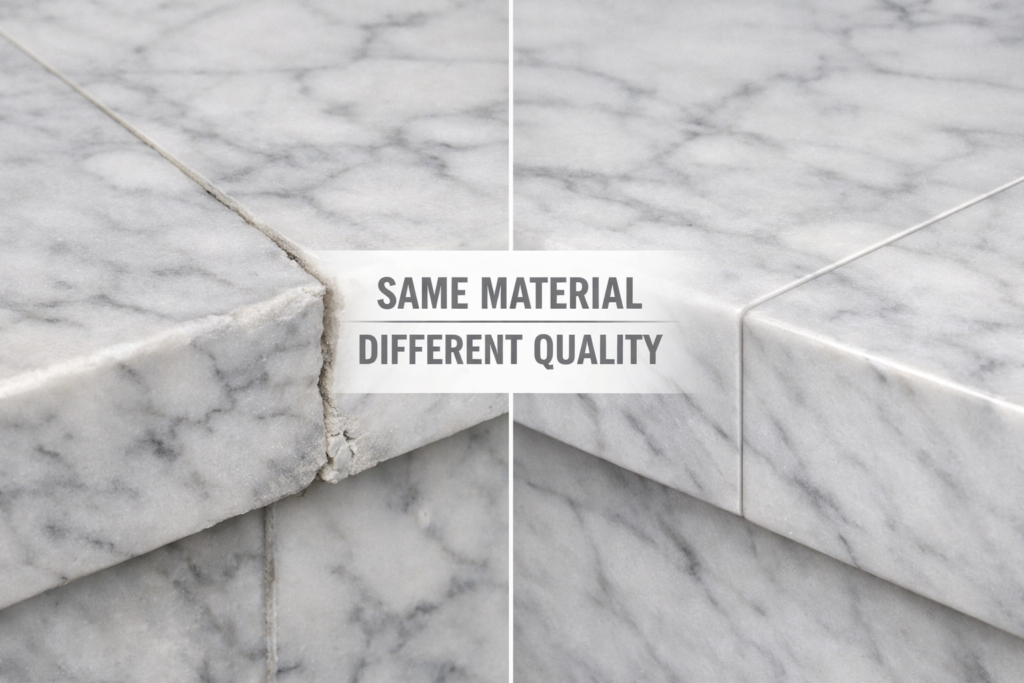
The same material can produce two completely different outcomes.
Example:
A ₹10 lakh marble floor:
- uneven joints
- poor alignment
- inconsistent polishing
Feels cheap.
The same marble:
- seamless joints
- precise layout
- controlled finish
Feels exceptional.
What Craftsmanship Actually Means
Most people misunderstand craftsmanship.
They think it is:
- handwork
- detailing
- decoration
That is only the visible part.
1. Visible Craftsmanship
- clean joints
- sharp edges
- perfect alignments
- custom detailing
This shapes perception.
2. Invisible Craftsmanship
- structural accuracy
- waterproofing
- installation precision
- coordination between trades
This shapes performance.
Real craftsmanship begins long before finishes are applied.
It exists in:
- how walls align
- how openings are set
- how systems integrate
And continues until the final detail.
Why Craftsmanship Is Now Driving Value
This is where the market has changed.
1. It Directly Affects Longevity
Quality execution reduces:
- maintenance
- failure points
- long-term cost
Appraisers and buyers increasingly recognize that strong craftsmanship improves durability and reduces depreciation.
2. It Shapes Emotional Experience
Craftsmanship is not always visible.
But it is always felt.
- doors close differently
- surfaces feel refined
- spaces feel aligned
Luxury is experienced through precision.
3. It Cannot Be Replicated at Scale
Materials can be sourced.
Brands can be copied.
But craftsmanship depends on:
- skill
- time
- coordination
- intent
Which makes it rare.
4. It Ages Better Than Materials
Many modern homes rely on:
- engineered finishes
- modular systems
- prefabricated solutions
These often:
- wear out
- date quickly
- feel repetitive
There is a growing shift toward craft-based design and bespoke construction, as clients recognize that modular “luxury” lacks individuality and longevity.
The Rise of Craft in Modern Luxury
Across global luxury design, a quiet shift is happening.
Craftsmanship is no longer:
- an upgrade
- a detail
- a finishing layer
It is becoming:
The foundation of value
Even in broader luxury industries, craftsmanship is emerging as the primary currency of authenticity and differentiation, as consumers move away from surface-level luxury.
Why Expensive Homes Still Feel Cheap
This is the uncomfortable truth.
Many high-budget homes fail because:
- materials are chosen before design clarity
- execution is fragmented
- detailing is rushed
- coordination is missing
Which leads to:
👉 expensive inputs
👉 average outcomes
The Delhi NCR Reality
This gap is especially visible in Delhi NCR.
Where luxury is often defined by:
- imported materials
- brand-driven decisions
- surface-level finishes
But the real issue is:
👉 execution quality is inconsistent
This is why:
Two homes with similar budgets can feel completely different.
The Real Definition of Luxury
Luxury is not:
- how expensive something looks
Luxury is:
how well it is made
The Deeper Shift
Earlier, clients asked:
“What materials are being used?”
Now, the smarter question is:
“How is this being built?”