

For decades, homes were designed in a simple way.
Room by room.
- Living room
- Dining room
- Kitchen
- Bedrooms
Each space defined.
Each function fixed.
It was clear.
It was structured.
And it is now becoming outdated.
The Shift That Is Quietly Redefining Homes
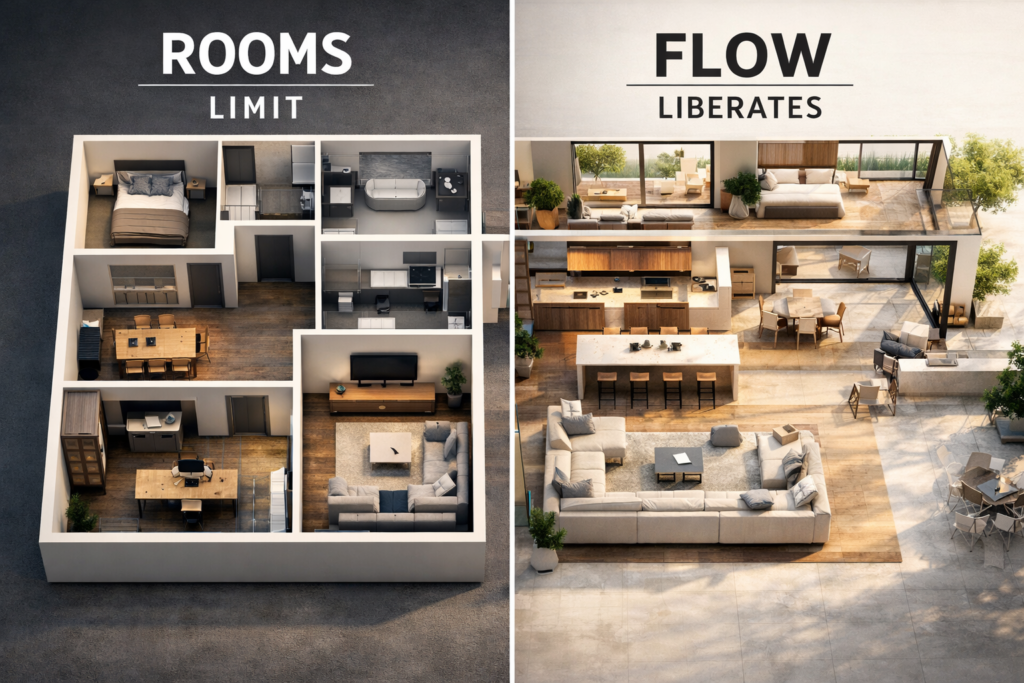
Luxury homes today are no longer being designed as collections of rooms.
They are being designed as continuous experiences.
This is not a stylistic change.
It is a structural one.
Across global design, the focus has shifted toward:
- how spaces flow
- how they are used daily
- how they adapt over time
Instead of how they are labeled.
Design in 2026 is increasingly driven by how a space feels and functions in real life, not just how it looks
Why the Old Room-Based Model Is Breaking
The traditional model worked for a different lifestyle.
- fixed routines
- predictable usage
- clear separation between functions
But modern living is no longer structured that way.
1. Life Is No Longer Linear
A single space now supports:
- work
- relaxation
- social interaction
- personal time
Often within the same day.
Rigid rooms cannot adapt to this.
2. Rooms Create Inefficiency
When spaces are defined too narrowly:
- they remain underused
- they disconnect from each other
- they reduce flexibility
This is why many large homes still feel inefficient.
Not because of size.
But because of how space is divided.
3. Experience Is Now Continuous
People no longer experience homes as isolated rooms.
They experience:
- movement
- transitions
- light flow
- spatial connection
This is where luxury is now defined.
What Is Replacing Room-Based Design
The new approach is not about removing rooms.
It is about redefining how they relate to each other.
From Rooms → To Zones
Instead of fixed rooms, spaces are now designed as:
- social zones
- private zones
- transition zones
- work zones
Each connected, not isolated.
From Walls → To Flow
The focus shifts to:
- how spaces open
- how they connect visually
- how movement feels
Not just how they are separated.
From Function → To Behavior
Earlier:
“this is a living room”
Now:
“this is how the space will be used throughout the day”
The Real Reason This Shift Is Happening
This is not design experimentation.
It is a response to deeper changes.
1. Hybrid Lifestyles
Homes now accommodate:
- work
- leisure
- family
- solitude
Often simultaneously.
2. Emotional Design
Luxury is no longer defined by:
- materials
- finishes
But by:
- comfort
- ease
- spatial experience
3. Long-Term Thinking
Homes are expected to:
- adapt
- evolve
- remain relevant
Not remain static.
Design trends now emphasize longevity and meaningful use over temporary aesthetics.
Where Most Homes Still Go Wrong
Despite the shift, most homes are still designed using the old model.
Which leads to predictable issues.
1. Dead Spaces
Rooms that exist
but are rarely used.
2. Broken Flow
Spaces that feel disconnected.
Movement becomes:
- inefficient
- unnatural
3. Over-Segmentation
Too many divisions create:
- visual clutter
- spatial restriction
4. Poor Adaptability
Spaces cannot evolve with:
- lifestyle changes
- family needs
What Modern Luxury Homes Do Differently
This is where the real difference appears.
1. They Design Around Daily Life
Instead of asking:
“What rooms do we need?”
They ask:
“How will this home be lived in?”
2. They Prioritize Transitions
The focus is not just on rooms.
But on:
- how one space leads into another
- how light moves
- how openness is controlled
3. They Create Multi-Layered Spaces
A single space can:
- expand
- contract
- adapt
Without losing clarity.
4. They Reduce Unnecessary Boundaries
Not by removing structure.
But by making it:
- intentional
- meaningful
5. They Feel Cohesive
Everything connects:
- architecture
- interiors
- lighting
- movement
As one system.
The Delhi NCR Reality
This shift is critical in Delhi NCR.
Because:
- plots are valuable
- space efficiency matters
- lifestyle expectations are evolving rapidly
Yet many homes still follow:
👉 outdated room-based planning
Which results in:
- wasted space
- compromised usability
- reduced long-term value
The New Definition of Planning
Planning is no longer:
- dividing space
Planning is:
designing experience
The Real Shift
Earlier, homes were designed like plans.
Now, they are designed like journeys.