

Luxury kitchens used to be judged by what they displayed.
The marble island.
The imported appliances.
The seamless shutters.
The statement lighting.
The premium hardware.
For years, the kitchen became a showpiece.
But the luxury kitchen is changing.
It is no longer just a place where food is cooked.
It is where family life, hosting, staff movement, storage, wellness, service, and daily rhythm all meet.
That is why the modern luxury kitchen is not one beautiful room.
It is a system.
The Kitchen Has Become the Home’s Operating Centre
In older homes, the kitchen was mostly functional.
It stayed separate.
It supported the household quietly.
It did not need to perform socially.
Then open-plan living changed the kitchen.
The kitchen became visible from dining rooms, lounges, and family areas. It became a place for informal conversation, breakfast, hosting, and social interaction.
Now, luxury homes are entering the next stage.
The kitchen must be both visible and operational.
It must look calm.
It must cook well.
It must hide clutter.
It must support staff.
It must serve guests.
It must store intelligently.
It must handle daily Indian cooking.
It must remain beautiful while doing real work.
That is not a kitchen.
That is architecture.
Why the “Invisible Kitchen” Is Trending
One of the strongest global kitchen trends for 2026 is the invisible kitchen.
House Beautiful describes the invisible kitchen as a major 2026 direction, built around concealed appliances, seamless cabinetry, hidden storage, appliance garages, and scullery-style back-of-house areas that allow kitchens to blend quietly into open living spaces. The purpose is not to make the kitchen disappear. It is to preserve visual calm while keeping function intact.
This trend matters because it reveals a larger shift.
Luxury homeowners do not want kitchens that look constantly busy.
They want kitchens that can perform without disturbing the calm of the home.
That is especially relevant when the kitchen is connected to living and dining areas. A cluttered counter, visible appliances, heavy smell, or noisy preparation can affect the entire experience of the home.
The invisible kitchen is really about one thing:
Control.
India Needs a More Intelligent Kitchen Logic
But Indian luxury homes cannot copy Western kitchen trends blindly.
Indian cooking is different.
It often involves:
- stronger aromas
- heavier preparation
- more utensils
- more storage
- more wet work
- more oil and spice
- longer cooking sessions
- staff-assisted cooking
- festival-scale preparation
- frequent family hosting
A minimal, fully open kitchen may look elegant in a photograph but fail in daily Indian use.
This is where luxury kitchen planning in India must become more intelligent.
The answer is not simply to hide everything.
The answer is to create layers.
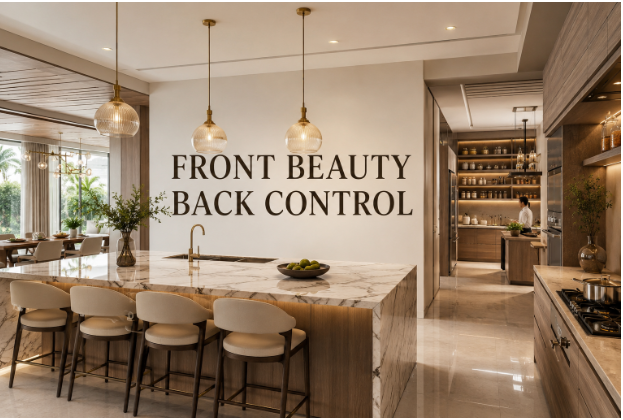
A beautiful front kitchen.
A powerful back kitchen.
A smart pantry.
A clear service route.
A practical utility zone.
A dining connection that works.
The future luxury kitchen in India is not one kitchen.
It is a layered kitchen system.
The Back Kitchen Is Not Secondary
Many people misunderstand the back kitchen.
They think of it as a compromise.
A less beautiful space.
A hidden service zone.
Something added only when there is extra area.
That is wrong.
In a serious luxury home, the back kitchen protects the luxury of the front kitchen.
The front kitchen can remain calm, social, and visually refined because the back kitchen handles the real intensity of cooking.
It manages:
- heavy preparation
- washing
- storage
- staff work
- strong aromas
- catering support
- festival cooking
- utility functions
- service movement
Architectural Digest’s 2026 entertaining coverage notes that some homeowners and designers are moving toward partially concealed kitchens, hidden wet bars, and even full catering kitchens for clients who entertain frequently, so preparation and mess do not dominate the guest experience.
That is exactly the logic Indian luxury homes need.
The back kitchen is not where luxury disappears.
It is where luxury is protected.
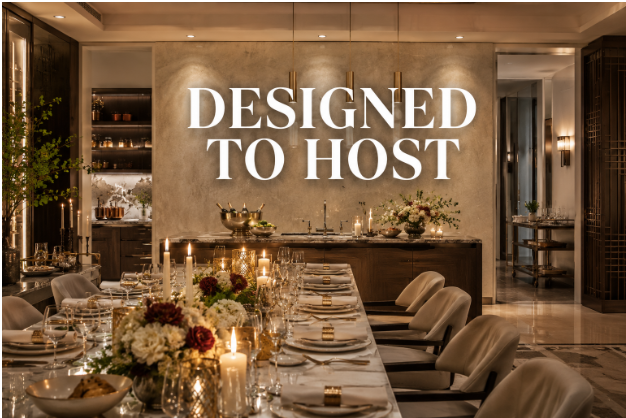
The Luxury Kitchen Must Support Hosting
Indian luxury homes are deeply connected to hosting.
Family dinners.
Festive meals.
Pooja preparation.
Evening tea.
Formal dinners.
Private parties.
Outdoor dining.
Large family gatherings.
The kitchen must support all of this without creating chaos.
That means it needs more than a beautiful island.
It needs:
- pantry support
- dining service routes
- plate storage
- serving counters
- staff access
- dish clearing logic
- appliance planning
- wet and dry zones
- connection to outdoor rooms
- connection to formal and family dining
A kitchen that cooks well but hosts badly is incomplete.
A luxury kitchen must understand the rituals of the house.
Not just the recipes.
The Island Is Evolving
The kitchen island became the symbol of the luxury kitchen.
But not every island is good design.
Many islands are added because they look premium, not because they improve the kitchen.
A good island should clarify how the kitchen works.
It can support:
- breakfast
- serving
- plating
- casual conversation
- children’s homework
- informal hosting
- storage
- appliance integration
- visual anchoring
Homes & Gardens’ 2026 kitchen island trend coverage points toward more personalized, furniture-inspired, sculptural, and multifunctional islands with mixed storage, softer forms, integrated outlets, and layered materiality.
That is the right direction.
The island is no longer only a counter.
It is becoming a social object.
But in Indian homes, it still needs discipline.
If the island blocks movement, interrupts staff flow, collects clutter, or exists only for visual drama, it weakens the kitchen.
A kitchen island should not fill the room.
It should improve the room.
Storage Is the Hidden Luxury
A kitchen is never calm without storage.
Luxury kitchens often fail not because they lack expensive finishes, but because they lack intelligent storage.
Indian kitchens need storage for:
- dry groceries
- spices
- appliances
- utensils
- festival serveware
- daily crockery
- bulk purchases
- cleaning supplies
- staff-use items
- children’s food
- wellness ingredients
- dining accessories
If storage is weak, the kitchen becomes visually noisy.
Counters fill up.
Cabinets overflow.
The pantry becomes chaotic.
Staff waste time searching.
The front kitchen loses its calm.
This is why hidden storage, appliance garages, tall pantry walls, utility cabinetry, and scullery-style support areas are becoming central to luxury kitchens. House Beautiful’s reporting on invisible kitchens highlights precisely this: hidden storage and back-of-house scullery spaces are becoming essential because open living requires kitchens to look composed even while functioning heavily.
Storage is not a secondary detail.
Storage is what protects elegance.
Kitchens Affect Cognitive Ease
A badly planned kitchen creates stress.
Not dramatic stress.
Small, repeated stress.
Searching for things.
Walking too much.
Working around clutter.
Bending unnecessarily.
Reaching awkwardly.
Managing poor light.
Handling confusing storage.
Moving around staff or family members.
These details affect how easy the home feels.
A 2026 study on visual accessibility in virtual kitchens found that open shelving reduced task duration and movement demands among older adults during item-retrieval tasks, suggesting that visibility and organization can affect how efficiently people use a kitchen.
Another 2026 study on inclusive kitchen design for older adults with mild cognitive impairment found strong preference for kitchens with open layouts, better lighting, non-slip flooring, reduced clutter, and clearer visibility. Participants preferred the redesigned kitchens as more cognitively friendly in 87.4% of comparisons.
The luxury lesson is simple.
Good kitchens reduce cognitive load.
They make daily life easier without announcing it.
Lighting Defines the Kitchen Experience
Kitchen lighting is often treated as decoration.
It is not.
A luxury kitchen needs layered lighting:
- task lighting for preparation
- ambient lighting for mood
- under-cabinet lighting for counters
- island lighting for social use
- pantry lighting for visibility
- back-kitchen lighting for work
- soft evening lighting for open living
A kitchen that is too bright feels clinical.
A kitchen that is too dim becomes impractical.
A kitchen with poor task lighting becomes frustrating.
Lighting must shift between work and atmosphere.
This is especially important when the kitchen connects to dining or living areas. The same space may need to support morning breakfast, afternoon staff preparation, evening hosting, and late-night calm.
A luxury kitchen should not have one mood.
It should have rhythm.
Ventilation Is Non-Negotiable in Indian Luxury Kitchens
This is one of the biggest mistakes in copied kitchen design.
A kitchen may look minimal, but if ventilation is weak, the home suffers.
Indian cooking needs serious ventilation.
Not only for smell.
For heat, oil, smoke, moisture, and comfort.
The kitchen system must think about:
- chimney placement
- duct routes
- fresh air
- cross-ventilation
- back-kitchen exhaust
- separation from living zones
- air-conditioning logic
- serviceability of filters
- smell control near dining areas
A beautiful open kitchen with weak ventilation becomes a daily problem.
Luxury is not only how the kitchen photographs.
It is how the home smells after cooking.
The Kitchen Must Manage Three Worlds
This is the most important framework for Indian luxury homes.
A luxury kitchen must balance three worlds.
1. The Family World
Daily breakfast.
Children’s food.
Tea.
Quick meals.
Family conversation.
Late-night snacks.
Health routines.
2. The Guest World
Hosting.
Serving.
Formal dining.
Outdoor meals.
Visual calm.
Social presence.
3. The Service World
Cooking.
Cleaning.
Storage.
Staff movement.
Utility work.
Waste management.
Catering support.
Most kitchens fail because they serve one world and ignore the others.
A purely beautiful kitchen fails service.
A purely functional kitchen fails hosting.
A purely open kitchen may fail Indian cooking.
A purely hidden kitchen may fail family connection.
The best luxury kitchen balances all three.
The Delhi NCR Context
This matters naturally in Delhi NCR because high-end homes here often involve multigenerational families, staff-assisted living, frequent hosting, larger kitchens, private dining, formal entertaining, and high expectations around both aesthetics and function.
The kitchen cannot be designed as an isolated Western-style image.
It must respond to:
- family size
- staff movement
- hosting culture
- storage needs
- heavy cooking
- service access
- ventilation
- dust
- heat
- formal and informal dining
In this context, a luxury kitchen is not only a design statement.
It is a performance space.
What Smarter Luxury Kitchens Do Differently
1. They Separate Show and Service
They allow the front kitchen to remain elegant while the back kitchen handles intense cooking and utility work.
2. They Plan Storage Before Styling
Every appliance, utensil, grocery type, serving item, and cleaning object has a place before finishes are finalized.
3. They Control Smell and Heat
Ventilation, exhaust, zoning, and kitchen placement are planned architecturally, not solved later.
4. They Connect to Dining Properly
Food movement, clearing, serving, and guest experience are part of the plan.
5. They Support Staff Without Disturbing Family Life
Staff movement is clear, efficient, and respectful.
6. They Use Islands With Purpose
The island is designed for real use, not just visual impact.
7. They Make Work Invisible Without Making Function Weak
The best kitchens hide clutter, not capability.
The New Definition of a Luxury Kitchen
A luxury kitchen is not defined by the most expensive stone.
Or the biggest island.
Or the most imported appliance.
It is defined by how well it supports life.
It should be beautiful enough to belong to the living experience.
And strong enough to handle daily reality.
It should host gracefully.
Store intelligently.
Cook seriously.
Serve smoothly.
Stay calm visually.
Reduce stress operationally.
That is the new luxury kitchen.