

A luxury home is not truly tested on the day it is handed over.
It is tested after the family starts living in it.
When the air-conditioning runs every day.
When the bathrooms are used every morning.
When the kitchen handles real cooking.
When the wardrobes carry real clothes.
When the terrace faces heat, dust, and rain.
When the basement meets monsoon humidity.
When the smart-home system needs support.
When the lights need servicing.
When the marble needs care.
When staff begin cleaning, operating, and maintaining the home.
That is when the truth appears.
A home may look flawless on handover day.
But if the owner does not know how to maintain it, service it, repair it, clean it, access it, or protect it, the home slowly becomes stressful.
That is why luxury homes need better maintenance planning before handover.
Because true luxury is not only a home that looks perfect once.
It is a home that remains easy to own for years.
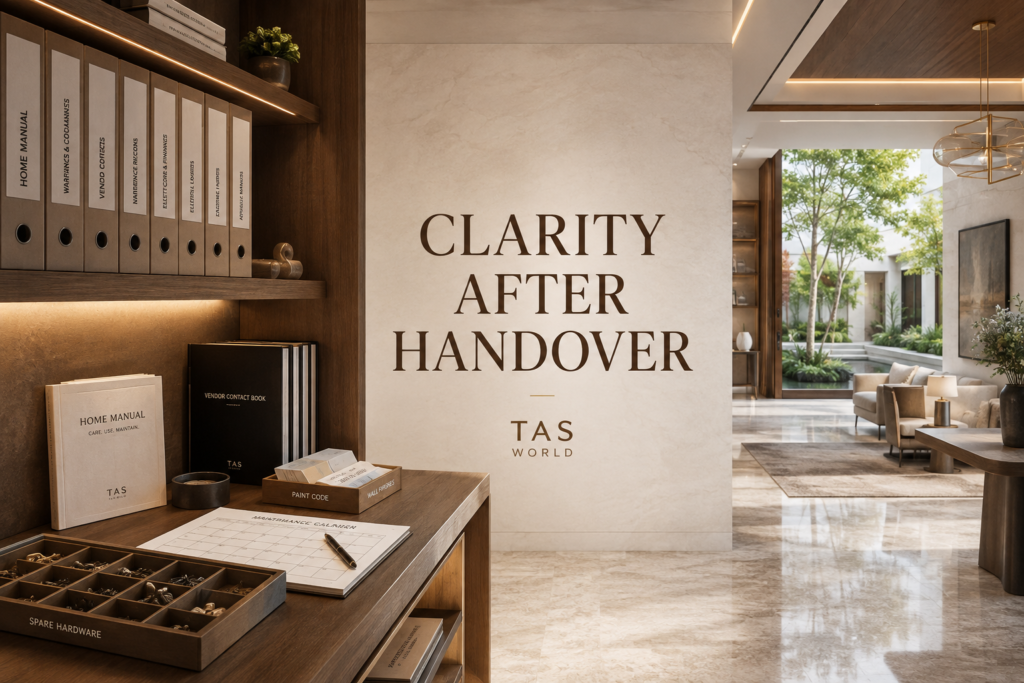
Handover Is Not the Finish Line
Many people treat handover as the end of a project.
The site is cleaned.
The furniture is placed.
The lights are switched on.
The photos are taken.
The keys are given.
But for the homeowner, handover is not the end.
It is the beginning of ownership.
This is where many luxury homes expose weak planning.
The AC filter is hard to access.
The smart-home app is still controlled by the vendor.
The lighting scenes are not documented.
The stone care instructions are unclear.
The waterproofing record is missing.
The paint code is forgotten.
The terrace drain gets blocked.
The bathroom exhaust is never serviced.
The staff does not know which cleaning chemicals to avoid.
The client does not know which vendor installed what.
The home looks finished, but the operating system is missing.
A serious luxury home should not be handed over as an image.
It should be handed over as a complete, maintainable living system.
The Luxury Problem Nobody Talks About
Most luxury discussions focus on visible upgrades.
Imported marble.
Custom furniture.
Premium lighting.
Designer bathrooms.
Luxury kitchens.
Smart automation.
Outdoor terraces.
Walk-in wardrobes.
Basements.
Home theatres.
But every premium feature adds maintenance responsibility.
A marble floor needs the right cleaner.
A wooden ceiling needs humidity awareness.
A smart-home system needs documentation.
A basement needs moisture checks.
A terrace needs drainage inspection.
An outdoor kitchen needs weather protection.
A bathroom needs exhaust cleaning.
A fresh-air system needs filter replacement.
A custom wardrobe needs hardware care.
A luxury home is not low-maintenance by default.
In fact, the more complex the home, the more important maintenance planning becomes.
The difference is this:
A badly planned luxury home creates invisible work.
A well-planned luxury home organises that work before it becomes a problem.
The Market Is Moving Toward Service-Led Luxury
The luxury housing market is moving beyond only location, size, and finishes. Branded residence and premium residential discussions in India increasingly focus on lifestyle services, long-term operations, and managed living. Hindustan Times recently reported on Delhi NCR’s rising interest in five-star branded residences, where buyers are drawn to managed services, hospitality-style living, and the promise of convenience.
But this also exposes a deeper issue.
Luxury residential assets can struggle when post-handover maintenance and operations are weak. Chambers’ 2026 India guide on hotel management and branded residences notes that several luxury developments have faced governance disputes, inconsistent maintenance, fragmented operational management, upkeep-budget disputes, and deterioration of common infrastructure over time.
That lesson applies directly to private luxury homes too.
A home is not successful only because it is beautifully created.
It must also be intelligently operated.
Maintenance Should Be Designed, Not Improvised
Maintenance planning should not be a last-week checklist.
It should influence design decisions from the beginning.
Where will service access be?
How will filters be changed?
Where will AC units be reached?
Where will terrace drains be checked?
Where will smart-home equipment be stored?
Where will spare tiles and stone be kept?
How will staff clean delicate finishes?
How will the family know which product warranties exist?
How will outdoor furniture be protected in monsoon?
How will bathroom exhausts be serviced?
How will the basement be inspected?
How will future repairs happen without breaking finished interiors?
These questions are not boring.
They are luxury ownership questions.
A home that is hard to maintain slowly becomes hard to enjoy.
Documentation Is Luxury
Documentation may not feel glamorous.
But in a high-end home, it is one of the most important parts of handover.
A proper luxury home handover should include:
- as-built drawings
- MEP layouts
- plumbing routes
- electrical circuit details
- lighting schedules
- smart-home documentation
- equipment manuals
- warranties
- vendor contacts
- material schedules
- finish schedules
- paint codes
- stone details
- spare inventory
- maintenance calendar
- snag closure record
- operating instructions
Construction handover guidance commonly treats as-built drawings, operation and maintenance manuals, warranties, testing records, spares, and owner walkthroughs as essential close-out documents, not optional extras.
This is the mindset luxury homes need.
The owner should not inherit confusion.
The owner should inherit clarity.
As-Built Drawings Protect the Future
A design drawing shows intent.
An as-built drawing shows what was actually built.
That difference matters.
During construction, things change.
A pipe shifts.
A duct is rerouted.
A conduit changes.
A ceiling access panel moves.
A light point is adjusted.
A wall thickness varies.
A drain line is modified.
If these changes are not documented, future maintenance becomes guesswork.
When a repair is needed, the team may not know where services are hidden.
Walls may be broken unnecessarily.
Ceilings may be opened blindly.
Electrical faults may take longer to trace.
Plumbing leaks may become more invasive.
A luxury home should not depend on memory.
It should have records.
As-built drawings protect the home from careless future intervention.
Warranties Are Useful Only If They Are Organised
A warranty is only valuable if the owner can find it, understand it, and use it in time.
In many homes, warranties are scattered.
Some are with vendors.
Some are in email.
Some are inside product boxes.
Some are never transferred.
Some expire before anyone remembers them.
Some require proof of service.
Some need installation details.
Some need serial numbers.
A luxury home should have a warranty register.
It should include:
- product name
- brand
- model number
- serial number
- vendor contact
- purchase date
- installation date
- warranty duration
- service terms
- claim process
- invoice reference
- AMC details where relevant
Without this, the owner may pay for repairs that should have been covered.
That is not luxury.
That is poor handover discipline.
Material Care Must Be Explained
Luxury materials need respect.
Marble.
Travertine.
Wood.
Veneer.
Brass.
Leather.
Fabric.
Wallpaper.
Lime plaster.
Microcement.
Outdoor stone.
Decorative metal.
Each material behaves differently.
Marble can stain.
Wood can move.
Brass can patinate.
Leather can dry.
Fabric can trap dust.
Wallpaper can fail in dampness.
Lime plaster may need careful touch-up.
Outdoor finishes face heat and rain.
A material is not luxurious only because it is expensive.
It becomes luxurious when it can age with dignity.
For that, the homeowner and staff must know how to care for it.
Which cleaner should be used?
Which cleaner should be avoided?
How often should polishing happen?
What should be sealed?
What should not be scrubbed?
How should spills be handled?
How should outdoor materials be protected before monsoon?
A luxury interior design India project should not end with material installation.
It should include material education.
HVAC Maintenance Is a Luxury Comfort Issue
Air-conditioning is not just a machine in a luxury home.
It affects comfort, indoor air quality, noise, energy, humidity, and daily experience.
Poor HVAC maintenance leads to:
- weak cooling
- dusty air
- smell
- noisy operation
- water leakage
- higher power use
- uneven comfort
- filter clogging
- poor air quality
A luxury handover should clearly explain:
- filter locations
- filter cleaning schedule
- service access points
- equipment model details
- thermostat settings
- fresh-air system logic
- duct cleaning requirements
- drain line checks
- vendor contacts
- AMC recommendations
This connects directly to indoor air quality.
A home cannot remain healthy if its air systems are not maintainable.
Smart Homes Need Operational Clarity
A smart home can feel impressive at handover.
Lights respond.
Curtains move.
Music plays.
Security cameras work.
Scenes are activated.
But smart homes can become frustrating if documentation is weak.
Who owns the app account?
Who has admin access?
Are default passwords changed?
Where is the network rack?
What happens if the internet fails?
How are lighting scenes edited?
Which vendor controls the system?
Are backups available?
Can staff access only selected controls?
Can elders use physical switches?
Is there a manual fallback?
Smart-home commissioning and handover guidance for India stresses the importance of device inventory, network segmentation, failover testing, security hardening, configuration backups, acceptance sign-off, and an as-built handover pack.
This is critical.
A smart home should not become dependent on one technician’s memory.
Luxury technology must remain understandable, secure, and serviceable.
Bathrooms Need Maintenance Planning
Bathrooms are high-risk zones.
They deal with water, steam, slope, drainage, stone, grout, glass, fittings, mirrors, vanities, exhaust, and daily use.
A bathroom can look beautiful at handover and still fail later if maintenance is not planned.
Common issues include:
- blocked drains
- weak exhaust
- damp vanities
- hard-water marks
- stained stone
- loose fittings
- mould near wet zones
- poor towel drying
- slippery surfaces
- leaking concealed plumbing
A luxury bathroom should include:
- drainage details
- exhaust service guidance
- stone care instructions
- glass cleaning instructions
- fitting warranty records
- concealed plumbing information
- slope and waterproofing documentation
- recommended cleaning products
- maintenance schedule
A bathroom is not luxurious if it becomes damp, stained, or difficult to keep fresh.
Basements Need Long-Term Monitoring
Basements are among the most maintenance-sensitive spaces in Delhi NCR luxury homes.
They may be used for:
- theatre
- gym
- bar
- spa
- parking
- storage
- services
- staff areas
- entertainment
But basements face risks.
Moisture.
Water ingress.
Poor ventilation.
Humidity.
Pump failure.
Smell.
Mould.
Lighting failure.
Drainage issues.
A basement should never be handed over only as a finished room.
It needs a monitoring plan.
The owner should know:
- waterproofing details
- sump pump information
- drainage points
- ventilation system
- humidity-control system
- emergency access
- inspection schedule
- warning signs
- service vendor details
No amount of luxury interior finishing can compensate for a basement that is not maintained properly.
Terraces and Outdoor Areas Need Seasonal Care
Outdoor spaces are becoming important in luxury homes.
Terraces.
Pergolas.
Outdoor kitchens.
Pool decks.
Garden seating.
Balconies.
Courtyards.
But outdoor areas age faster because they face weather.
Heat.
Dust.
Rain.
Wind.
UV exposure.
Drainage pressure.
Plants.
Pests.
Waterproofing risk.
A good handover should include:
- terrace drain map
- waterproofing record
- outdoor light warranty
- furniture care instructions
- pergola maintenance
- exterior flooring care
- outdoor kitchen service checklist
- cushion storage plan
- monsoon preparation checklist
- irrigation system guidance where relevant
Outdoor luxury is not created only through beautiful styling.
It is protected through seasonal maintenance.
Kitchens and Outdoor Kitchens Need Service Logic
Kitchens carry real work.
Cooking.
Steam.
Oil.
Smoke.
Spills.
Appliances.
Waste.
Water.
Storage.
Exhaust.
Indian kitchens especially need strong operational planning.
A luxury kitchen handover should include:
- appliance manuals
- chimney and hood cleaning schedule
- duct details
- gas and electrical safety details
- countertop care
- cabinet care
- sink and drain maintenance
- hardware records
- spare parts information
- service vendor contacts
Outdoor kitchens need even more attention.
They face weather, heat, grease, dust, drainage, and pests.
If they are not easy to clean and service, they slowly stop being used.
A high-end kitchen is not only designed for cooking.
It is designed for repeated cleaning, servicing, and long-term performance.
Lighting Systems Need Service Access
Layered lighting defines modern luxury interiors.
But lighting systems also require maintenance.
LED drivers fail.
Dimmers need support.
Outdoor lights need weather protection.
Cove lights need access.
Chandeliers need cleaning.
Step lights need replacement.
Smart lighting scenes may need adjustment.
If lighting access is not planned, future repairs damage finished interiors.
A luxury lighting handover should include:
- lighting schedule
- circuit details
- driver locations
- dimmer details
- scene settings
- warranty records
- replacement specifications
- cleaning instructions
- access panel locations
A home should not require ceiling damage just to replace a driver.
Serviceability is part of elegance.
Staff Training Matters
Many Indian luxury homes are staff-supported.
That means staff need to understand how to maintain the home properly.
They should know:
- which cleaners to use
- which materials are delicate
- how to clean stone
- how to care for brass
- how to handle wood
- how to clean glass
- how to protect outdoor furniture
- how to check drains
- how to clean filters
- how to report early signs of dampness
- which rooms need special care
- how to operate lighting and smart-home scenes
- what not to touch
A luxury home can be damaged by well-intentioned but uninformed cleaning.
Maintenance planning should include staff instructions.
Not only owner instructions.
Spares Should Be Stored Properly
Every luxury home should retain important spares.
Tiles.
Stone pieces.
Paint codes.
Wallpaper rolls.
Veneer samples.
Hardware pieces.
Light specifications.
Fabric details.
Grout shades.
Special screws.
Hinges.
Switch modules.
Outdoor flooring extras.
These matter because materials change over time.
A tile may be discontinued.
A paint shade may vary.
A stone batch may not match.
A hardware model may become unavailable.
A light fitting may change.
If the home has spares, repairs become cleaner.
If not, even a small repair can become visibly mismatched.
Spares are not clutter.
They are insurance for the design.
Snagging Is Not a Formality
Snagging is the process of identifying and correcting defects before final acceptance.
In luxury homes, snagging should be serious.
Not rushed.
Not cosmetic.
Not only visual.
A snag list should cover:
- civil finish
- paint
- stone
- woodwork
- doors
- hardware
- lighting
- electrical
- plumbing
- HVAC
- bathrooms
- kitchen
- outdoor areas
- smart systems
- drainage
- glass
- alignment
- safety
- cleaning
Indian handover guidance for residential projects often includes snagging, accessible service voids, as-built drawing handover, warranty documentation, keys, and maintenance manuals as part of a disciplined handover process.
A luxury home should not be accepted because it looks “mostly done.”
It should be accepted when its defects have been documented, prioritised, corrected, and closed.
Maintenance Planning Protects the Budget
Poor maintenance planning creates future cost leakage.
A hidden leak damages cabinetry.
A blocked terrace drain causes seepage.
A dirty AC filter reduces performance.
A missing warranty leads to paid repair.
A wrong cleaner stains stone.
A smart-home issue requires emergency vendor support.
A basement humidity problem damages interiors.
A missing paint code makes touch-up visible.
A lack of spares creates mismatched repair.
These are avoidable costs.
Maintenance planning does not make a luxury home cheap.
It makes ownership more controlled.
The most expensive repair is often the one that could have been prevented.
Maintenance Planning Protects Time
Time is one of the biggest luxuries for high-value homeowners.
Without documentation, every problem becomes a search.
Who installed this?
Where is the warranty?
Which material was used?
Where is the service access?
Which vendor should be called?
Which filter fits?
Which paint shade is this?
Where is the spare tile?
What does this switch control?
How does this automation scene work?
This wastes time.
A proper handover system answers these questions before they become emergencies.
A luxury home should not force the owner to become an investigator.
Delhi NCR Homes Need This Even More
Maintenance planning is especially important in Delhi NCR.
Homes here deal with:
- dust
- intense heat
- monsoon pressure
- winter pollution
- terrace use
- basements
- builder-floor constraints
- staff-supported living
- outdoor areas
- heavy hosting
- high-value materials
- complex MEP systems
- smart-home integration
Gurugram’s recurring infrastructure and upkeep concerns are a reminder that premium real estate can still suffer when maintenance and planning systems are weak. Recent commentary noted that Gurugram’s glossy corporate and luxury image can be undermined by poor planning and upkeep during heavy rain, especially around drainage and public infrastructure.
Private homes cannot control the entire city.
But they can be designed and handed over with much stronger internal maintenance discipline.
This is where residential architects Delhi NCR, best architects in Delhi, and best interior designers in Delhi must think beyond visual design.
Luxury home design India must include ownership planning.
Design-Build Accountability Makes Maintenance Easier
Maintenance planning is much easier when architecture, interiors, construction, MEP, lighting, automation, procurement, and handover are coordinated by one accountable system.
Otherwise, information gets scattered.
The architect has one set of drawings.
The contractor has site changes.
The electrician has circuit knowledge.
The plumber knows pipe routes.
The carpenter knows hardware.
The lighting vendor knows driver locations.
The automation vendor controls settings.
The client receives fragments.
Design-build accountability brings these fragments together.
That is why a serious design-build luxury home should not end with keys.
It should end with clarity.
What a Luxury Handover Should Include
A serious luxury home handover should include the following:
1. As-Built Drawings
Architectural, interior, MEP, lighting, plumbing, HVAC, and smart-home documentation updated to actual site execution.
2. Warranty Register
All warranties organised by product, vendor, date, duration, and claim process.
3. Material Care Guide
Instructions for stone, wood, veneer, brass, fabric, leather, wallpaper, plaster, outdoor finishes, and specialty materials.
4. Maintenance Calendar
Monthly, quarterly, seasonal, and annual maintenance tasks.
5. Vendor Contact Sheet
Verified contacts for all major systems, materials, appliances, and services.
6. Smart-Home Manual
Access hierarchy, scene settings, network details, fallback controls, and support contacts.
7. HVAC and IAQ Service Plan
Filter cleaning, duct access, exhaust maintenance, fresh-air system care, and service schedule.
8. Waterproofing and Drainage Records
Terrace, basement, bathroom, balcony, and wet-area documentation.
9. Spare Material Inventory
Tiles, stone, paint codes, hardware, fabrics, wallpapers, lights, and special items.
10. Snag Closure Record
A documented list of issues found, resolved, pending, and accepted.
This is not bureaucracy.
This is ownership intelligence.
The New Definition of Luxury Maintenance
Luxury maintenance is not reactive repair.
It is planned care.
It means the home has been designed so systems can be accessed, materials can be protected, equipment can be serviced, staff can clean correctly, warranties can be used, and future repairs do not destroy finished spaces.
A luxury home should not depend on memory.
It should depend on systems.
It should not become fragile after handover.
It should become easier to own.
Conclusion
Luxury homes need better maintenance planning before handover because the real life of a home begins after the project is complete.
The lights will need service.
The AC filters will need cleaning.
The terrace drains will need inspection.
The bathrooms will need ventilation.
The basement will need monitoring.
The smart systems will need support.
The stone will need care.
The furniture will need protection.
The staff will need instructions.
The owner will need documentation.
A home that looks beautiful but is difficult to maintain becomes stressful over time.
A home that is handed over with clarity becomes easier to own.
That is the true standard of luxury.
Not only a perfect photograph.
Not only a beautiful first impression.
Not only expensive finishes.
But a home that remains graceful, functional, serviceable, and calm for years.
Because true luxury is not a home that looks perfect once.
It is a home that keeps working beautifully after life begins.
Pingback: Luxury Home Materials That Age Well in India | TAS World