

Delhi’s heat is unforgiving.
Summer temperatures rise beyond 45°C. Solar radiation is intense. Dust accumulates quickly. Monsoon moisture stresses exterior materials.
Yet many modern luxury homes still rely on exposed glass façades and single-layer walls.
The result is predictable:
Overheating
Heavy air-conditioning dependence
Material fatigue
Rising energy costs
Elite residential architects in Delhi NCR are increasingly turning to ventilated façade systems and double-skin architecture.
Not for aesthetics.
For performance.
What Is a Ventilated Façade?
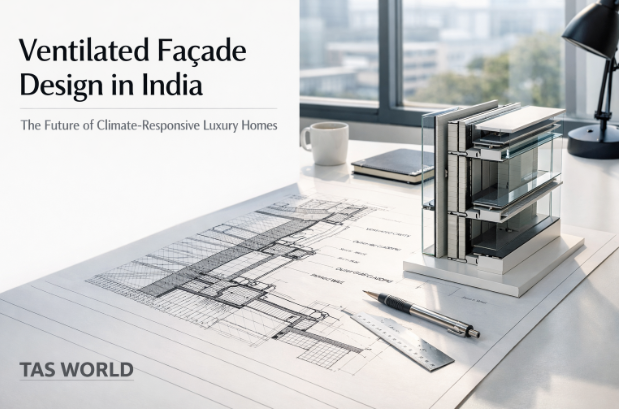
A ventilated façade, often called a double-skin façade, consists of three primary components:
- The structural wall
- An air cavity
- An external cladding layer
The key is the air gap between the inner wall and the outer skin.
When sunlight strikes the outer layer, heat is absorbed but does not transfer directly into the interior wall. Instead, the air cavity allows hot air to rise and escape through natural convection.
This simple physical principle significantly reduces thermal load.
In hot climate house design in India, that distinction is critical.
Why Double-Skin Systems Work in Indian Climate
In Delhi NCR, solar heat gain is one of the largest contributors to indoor temperature rise.
Traditional façades absorb heat directly. That heat transfers through the wall into interior spaces.
A ventilated façade interrupts this process.
The outer layer acts as a shield.
The cavity reduces conduction.
The airflow dissipates trapped heat before it reaches the interior structure.
This reduces cooling demand and improves thermal stability.
Luxury architecture firms in Delhi are increasingly integrating double-skin systems not as experimental features, but as performance necessities.
Energy Efficiency and Operational Savings
High-end homes often incorporate:
Large volumes
Double-height spaces
Expansive glazing
Without climate-responsive design, these spaces require constant mechanical cooling.
Ventilated facades reduce solar heat gain, which leads to:
Lower air-conditioning load
More stable indoor temperatures
Reduced electricity consumption
Long-term operational savings
Energy-efficient home design in Delhi is no longer optional. Rising energy costs and sustainability expectations demand smarter envelopes.
In luxury homes, efficiency is not about compromise. It is about intelligent engineering.
Material Longevity and Structural Protection
Delhi’s environment is not only hot. It is dusty and humid during monsoon.
Outer façade layers face:
UV radiation
Rainwater exposure
Dust accumulation
Thermal expansion and contraction
A double-skin façade protects the primary structural wall from direct exposure.
This:
Reduces cracking
Minimizes moisture penetration
Extends material lifespan
Protects interior finishes
When paired with proper waterproofing systems, ventilated façades enhance both heat resistance and monsoon resilience.
Luxury villa architects in India understand that durability protects value.
Acoustic Benefits in Urban Settings
Delhi NCR is dense and increasingly noisy.
Traffic corridors, construction activity, and urban growth generate constant background sound.
The air cavity in a double-skin façade adds an additional acoustic buffer.
This improves:
Indoor quietness
Bedroom comfort
Study and workspace focus
Overall spatial calm
For high-net-worth homeowners, acoustic privacy is a hidden marker of quality.
True luxury is often silent.
Why Most Homes Avoid Double-Skin Systems
If the advantages are clear, why are ventilated façades not standard?
Because they require:
Higher upfront investment
Precise structural planning
Detailed façade engineering
Careful site execution
Improperly designed air cavities can trap moisture. Poor detailing can compromise ventilation. Inadequate coordination between architect and contractor can undermine performance.
Double-skin systems are not decorative add-ons. They demand architectural discipline.
Modern Interpretations in Luxury Residential Architecture
Ventilated façades do not have to appear industrial.
In high-end residential architecture in Delhi NCR, they are expressed through:
Perforated stone screens
Metal jaali systems
Offset cladding panels
Layered glass envelopes
Contemporary reinterpretations of traditional shading elements
These systems create dynamic shadow patterns, depth, and texture while maintaining performance benefits.
This is where design meets engineering.
The Design-Build Advantage
Ventilated façades require coordination across:
Structural engineering
Thermal detailing
Waterproofing
Drainage planning
Cladding installation
Fragmented teams often struggle with this level of integration.
Design-build firms in Delhi NCR manage architecture and execution together, reducing risk and ensuring performance intent is preserved on-site.
In complex luxury homes, integration is not optional. It is protective.
The Future of High-End Architecture in Delhi
Luxury architecture in India is shifting.
Display is no longer enough.
Performance matters.
Homes must respond to:
Extreme heat
Dust exposure
Heavy rainfall
Urban noise
Ventilated façade systems represent a broader evolution in architectural thinking.
They signal maturity.
They reflect climate awareness.
They protect long-term value.