

Luxury homes used to be judged by visible things.
The address.
The façade.
The square footage.
The materials.
For a long time, that was enough.
A premium home proved its value through scale, spectacle, and surface.
That model is now changing.
Across the market, premium housing is becoming more dominant, but buyers are also becoming more selective about what they are actually paying for. In India, homes priced above ₹1 crore accounted for 50 percent of residential sales across the top eight cities in 2025, according to Knight Frank data reported by Business Standard. At the same time, current luxury housing coverage in India points to a shift toward conscious living, wellness, spacious yet meaningful layouts, and better quality of life rather than decorative excess alone.
That is the real shift.
Luxury is no longer defined by having more rooms.
It is increasingly defined by having spaces that can do more, better.
The old model of luxury planning is breaking
For decades, high-end homes followed a predictable planning logic.
A formal living room.
A formal dining room.
A family lounge.
A study.
A set of bedrooms.
A clear list of room labels.
It looked complete on plan.
But modern life no longer works in that fixed, compartmentalized way.
People now expect a home to support work, recovery, privacy, family interaction, entertaining, and personal retreat, often within the same day. Current reporting on home design trends describes flexibility itself as a new form of luxury, with “broken plan” layouts, zoning, and soft divisions replacing rigid spatial thinking because open, undifferentiated spaces often fail on privacy, noise control, and usability.
That means the traditional room-by-room model is no longer enough.
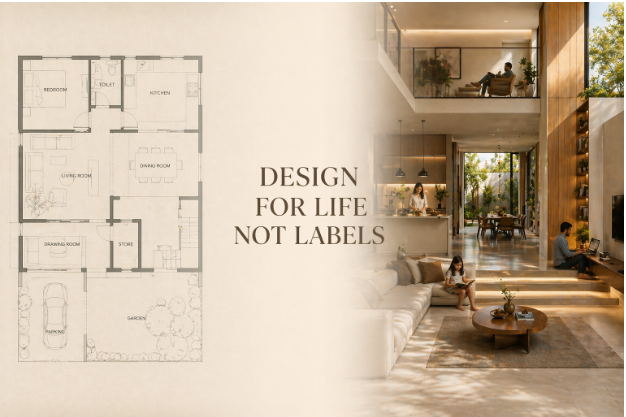
Why flexibility matters now
A luxury home today is expected to do more than impress.
It must support life as it actually happens.
That includes:
- routines that change through the day
- hybrid work
- private moments within family life
- emotional comfort
- long-term adaptability
- better use of every square foot
This is exactly why flexibility has become such a powerful design principle. HousingWire’s reporting on Zillow’s 2025 search behavior shows that buyers increasingly prioritize lifestyle, comfort, flexible living, outdoor access, and adaptable arrangements over scale or traditional luxury labels. Times of India’s design reporting points to the same pattern from a spatial angle: buyers want zoning, privacy, and multi-functional living instead of one-dimensional open plans.
So the question is no longer:
“How many rooms does the house have?”
It is:
“How intelligently does the house support the people inside it?”
What fixed planning gets wrong
Many expensive homes still fail in one of three ways.
1. They overbuild formal space
Large formal rooms often remain underused because they are designed for occasional impression, not daily life.
2. They underperform on real use
A room may look impressive in isolation, yet fail because it cannot adapt to changing needs, shifting family patterns, or blended routines.
3. They confuse size with usefulness
More built-up area does not guarantee more value. If the planning is rigid, the home may have more space but less relevance.
This is where many luxury homes quietly become inefficient. They are expensive to build, expensive to maintain, and visually strong, yet spatially outdated.
What flexible luxury actually looks like
Flexibility does not mean compromise. It does not mean making every room generic.
It means designing with enough intelligence that a home can evolve without losing clarity or elegance.
In a well-designed high-end home, flexibility appears as:
Layered zoning
Spaces are organized by privacy, mood, and routine rather than only by traditional labels.
Controlled openness
Instead of either closed rooms or fully open plans, spaces connect in a more deliberate way.
Multi-use intelligence
A room can host different uses across the day without feeling confused or temporary.
Better transitions
Luxury is no longer just in the room itself. It is in how one space leads into another.
Long-term relevance
A flexible home is more likely to remain useful, comfortable, and valuable over time.
This aligns with the larger market movement toward conscious, experience-led living. Luxury is increasingly being described not simply as possession, but as a better daily environment.
Why this matters even more in Delhi NCR
This shift is especially important in Delhi NCR.
Because here, poor planning becomes expensive very quickly.
High land values, dense surroundings, privacy concerns, heat, noise, staff movement, and changing family expectations mean that rigid layouts age badly. A house that cannot adapt begins to feel inefficient, no matter how premium the finishes are.
In a market where premium housing is expanding and buyers are increasingly upgrading toward better-quality homes, usability becomes a core differentiator, not a secondary detail. Business Standard’s reporting on Knight Frank data makes that very clear: the premium segment is growing, and demand is increasingly led by financially secure end-users upgrading to better homes, not simply bigger ones.
That makes flexibility more than a design preference.
It becomes a value strategy.
The new definition of luxury
The new luxury is not just more space.
It is better response.
A home that responds to:
- routines
- privacy
- emotion
- change
- long-term living
will always outperform a home designed only around labels, formality, or visual impact.
This is where luxury planning is headed.
From static rooms
to adaptive zones
From display
to daily lifeFrom rigid planning
to meaningful flexibility