

Some homes feel perfect on Day 1
The lighting is right.
The materials feel premium.
The scale feels impressive.
Everything looks like a reward.
And for a while, it is.
Then something changes.
Not suddenly.
But slowly.
Luxury home regret does not show up immediately.
It shows up after living in the house.
After routines settle.
After patterns repeat.
After the excitement fades.
The data confirms this
- Around 67% of homeowners report regrets after buying
- In luxury homes, regret is rarely about price
- It comes from compromises buyers didn’t fully understand at the time
The Core Truth
Luxury homes don’t fail instantly.
They fail slowly.
Why Luxury Buyers Start Regretting Their Homes
This is not random.
It follows a pattern.
1. The Home Doesn’t Match Real Life
Most buyers purchase based on:
- aspiration
- visual appeal
- emotional response
But daily life exposes:
- inefficiencies
- friction
- mismatch with routines
The shift
Buyers today want homes that support:
- work
- rest
- privacy
- flexibility
When a home cannot adapt, regret begins.
2. The Layout Looks Good, But Doesn’t Work
This is one of the most common failures.
Homes are often designed for:
- appearance
- symmetry
- visual impact
But not for:
- movement
- transitions
- real usage
Result:
- unused rooms
- awkward circulation
- disconnected spaces
3. Maintenance Becomes a Burden
This is the most underestimated factor.
Many luxury homes come with:
- high upkeep
- complex systems
- heavy operational demand
Real-world insight:
Unexpected maintenance costs are one of the most common regrets among homeowners
What buyers realise later:
👉 “This home is harder to live with than expected”
4. Emotion Led the Decision
Luxury buying is emotional.
That’s unavoidable.
But here’s the problem:
- stress
- urgency
- pressure
often override logic
Data:
- 66% of buyers report regret linked to pressure or emotional decisions
Result:
Buyers don’t regret buying a home.
They regret how they decided.
5. The Location Feels Different Over Time
At purchase, location is judged by:
- access
- status
- proximity
But over time, what matters is:
- noise
- privacy
- surroundings
- daily comfort
Insight:
Location regret is one of the most expensive mistakes buyers make
6. The Home Is Either Too Much or Too Little
This is subtle but powerful.
Too much:
- too large
- too complex
- too difficult to manage
Too little:
- not enough flexibility
- not enough usability
Reality:
Luxury is not about size.
It is about alignment.
7. The Home Doesn’t Age Well
This is where regret becomes permanent.
Problems appear over time:
- dated materials
- rigid layouts
- poor adaptability
Market shift:
Buyers are now valuing timelessness and long-term usability over trends
8. They Didn’t Think About Exit
This is the highest-level mistake.
Most buyers think about:
- buying
- designing
- living
Few think about:
- selling
- liquidity
- future buyer appeal
Insight:
A luxury home is not just a lifestyle asset.
It is a long-term decision with consequences.
The Real Framework
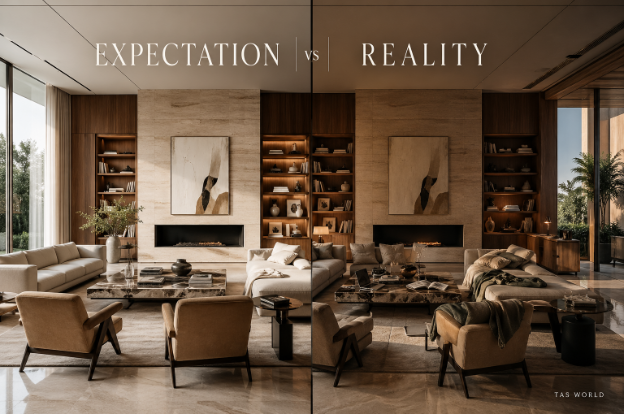
Luxury Regret =
Misalignment between:
- expectation
- reality
- time
The Delhi NCR Reality
This becomes even sharper in Delhi NCR.
Because:
- density
- noise
- environmental factors
- operational complexity
amplify every flaw in planning.
A home that feels impressive at purchase
can feel exhausting over time.
What Smart Buyers Do Differently
The best buyers don’t chase perfection.
They look for:
1. Usability over image
2. flexibility over fixed design
3. simplicity over complexity
4. long-term comfort over short-term impact
5. clarity over emotional decisions
They don’t ask:
“What looks luxurious?”
They ask:
What will still feel right after 5 years?
Final Insight
A luxury home should improve with time.
Not decline with it.