

Luxury homes used to be designed around one primary household.
Parents.
Children.
Guests.
Staff.
The structure was clear.
But that model is changing.
Today, many high-end homes are being expected to support more than one generation, more than one lifestyle, and more than one rhythm of living.
Grandparents.
Parents.
Young children.
Adult children.
Guests.
Caregivers.
Staff.
All under one architectural system.
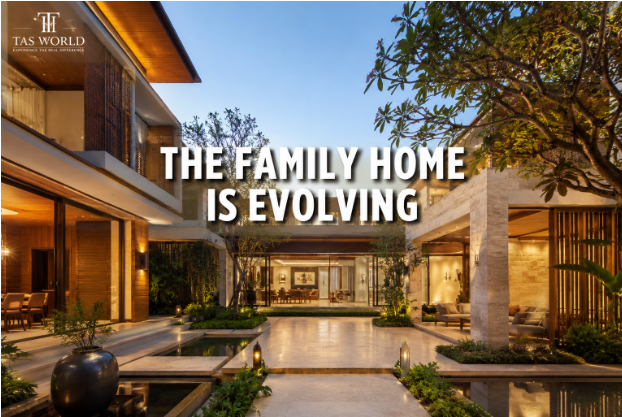
That is why multigenerational living is reshaping luxury home design.
Not because families simply need bigger homes.
Because they need more intelligent homes.
The Return of the Family Estate
Multigenerational living is no longer a niche idea.
Luxury market reports are now identifying it as a major direction in high-end real estate. Sotheby’s 2026 Luxury Outlook, reported by Florida Realtors, notes that wealthy buyers are prioritizing multigenerational layouts, privacy, and flexible spaces. The report also says many buyers are looking for homes that can accommodate aging parents, children, extended family, guesthouses, detached apartments, and multiple primary suites. (floridarealtors.org)
This is not only a Western shift.
It fits India deeply.
Indian luxury homes have always carried a family logic. But the older joint-family model is evolving. The modern high-end family does not want everyone compressed into one shared structure without privacy. It wants connection without friction. Proximity without intrusion. Togetherness without loss of independence.
That is the new architectural challenge.
Bigger Is Not Enough
The common mistake is to assume multigenerational homes simply need more area.
More bedrooms.
More lounges.
More bathrooms.
More parking.
More floors.
But size alone does not solve family complexity.
In fact, a large home can still fail if it does not manage privacy, movement, hierarchy, age, routine, noise, staff flow, and emotional boundaries.
A multigenerational luxury home is not successful because it is bigger.
It is successful because it is better zoned.
The Real Shift: From Shared House to Family Ecosystem
A traditional home is designed as a collection of rooms.
A multigenerational luxury home has to be designed as a family ecosystem.
It must support:
- shared life
- private life
- elder comfort
- children’s growth
- adult independence
- guest accommodation
- staff movement
- daily rituals
- long-term adaptability
That is why modern luxury homes are increasingly including private guest houses, self-contained wings, flexible layouts, and independent zones inside one estate. 2026 luxury home trend coverage describes this as a move toward independent, luxurious zones within a single property, where extended family members can live together while maintaining privacy and autonomy. (barrentinegroup.com)
This is the key.
The future family home is not one big shared space.
It is a series of connected private worlds.
Privacy Inside the Home Matters
Luxury homes often focus on privacy from the outside.
Boundary walls.
Security.
Landscape buffers.
Controlled entry.
But multigenerational living introduces a different kind of privacy:
Privacy within the family.
This is more delicate.
A grandparent may want quiet.
Parents may need a private retreat.
Teenagers may need independence.
Young children may need supervision.
Guests may need comfort without disrupting daily life.
Staff may need efficient circulation without crossing intimate zones.
A home that does not separate these layers becomes emotionally tiring.
Everyone is together.
But no one feels fully at ease.
That is why internal privacy is becoming one of the strongest markers of intelligent luxury planning.
Multiple Primary Suites Are Becoming More Important
In older luxury homes, there was usually one clear master suite.
But multigenerational homes often require a different hierarchy.
Parents may need one primary suite.
Grandparents may need another suite on a lower or more accessible level.
Adult children may need independent bedrooms with lounge or work areas.
Long-stay guests may need privacy equivalent to a small apartment.
Sotheby’s 2026 Luxury Outlook specifically notes that architects and designers are responding with multiple primary bedroom suites, private bathrooms, sitting rooms, and small office spaces that create a sense of equality across generations living together. (floridarealtors.org)
This is important.
Because luxury within a multigenerational home is not about one dominant suite.
It is about dignity for every generation.
Aging Parents Change the Design Brief
Aging parents transform the architectural brief.
A home that works for a young family may not work for elderly family members.
The design must think about:
- step-free movement
- lift access
- bedroom placement
- bathroom safety
- softer lighting
- quieter zones
- daylight access
- ventilation
- proximity to family areas
- privacy without isolation
This does not mean making the home look institutional.
The best multigenerational homes integrate accessibility invisibly.
Wide passages do not need to look medical.
Curbless showers can look elegant.
Handrails can be designed as architectural details.
Lifts can be integrated into the home’s spatial logic.
Ground-floor suites can feel premium, not compromised.
Real luxury is not only making a home beautiful.
It is making it usable across time.
Children and Adult Children Need Different Spaces
A child’s needs change quickly.
A play area becomes a study zone.
A study zone becomes a private lounge.
A bedroom becomes a semi-independent suite.
A young adult may eventually need privacy, work space, and a separate rhythm within the same home.
This is where many homes fail.
They are designed for the family’s current stage, not the family’s future.
Multigenerational luxury homes must allow rooms to evolve.
A children’s lounge should be able to become a teen zone.
A study should be able to become a bedroom.
A guest room should be able to become a caregiver room.
A lounge should be able to become a work retreat.
A floor should be able to become semi-independent if needed.
That is not over-planning.
It is future intelligence.
Shared Spaces Become More Important, Not Less
Multigenerational living does not mean everyone lives separately inside one building.
It means the home must balance separation with meaningful gathering.
The strongest family homes have shared anchors.
In India, these often include:
- dining spaces
- family lounges
- courtyards
- terraces
- pooja or mandir areas
- kitchens
- arrival courts
- verandahs
- gardens
These spaces hold the emotional life of the home.
They are where families gather, celebrate, eat, pray, host, and return to each other.
But they must be designed carefully.
A dining room should not only seat people.
It should support rituals.
A courtyard should not only bring light.
It should create family connection.
A mandir should not only occupy a corner.
It should hold emotional gravity.
A kitchen should not only function.
It should understand family culture, staff flow, and hosting patterns.
In Indian luxury homes, these shared spaces are not secondary.
They are the soul of the house.
Circulation Defines Peace
Multigenerational homes often fail because of circulation.
Not because rooms are missing.
Because paths conflict.
Guests cross private zones.
Staff pass through family lounges.
Children disturb elders.
Elders feel far from daily life.
Service movement interrupts formal areas.
Parking and entry sequences become chaotic.
A good multigenerational home separates circulation intelligently.
It may need:
- family entry
- guest entry
- staff entry
- service routes
- elder-friendly movement
- private bedroom corridors
- separate access for guest suites
- lift placement that serves everyone properly
This is not just planning.
It is emotional management through architecture.
A calm home is often a well-circulated home.
The Delhi NCR Reality
This topic matters deeply in Delhi NCR.
Because high-value family homes here face a particular set of pressures:
- expensive land
- dense surroundings
- privacy needs
- staff dependency
- parking requirements
- security concerns
- heat and dust
- multiple family decision-makers
- strong cultural importance of family living
Many luxury homes in Delhi NCR are still designed as large houses, not family systems.
That creates problems.
Rooms exist, but privacy is weak.
Area exists, but circulation is poor.
Facilities exist, but elder comfort is ignored.
Formal spaces exist, but daily family anchors are under-designed.
Multiple generations live together, but the architecture does not support autonomy.
The result is a home that is expensive but emotionally inefficient.
The New Family Luxury
The modern multigenerational luxury home must do something difficult.
It must allow people to live together without forcing them into each other’s lives all the time.
That means:
- private suites
- shared anchors
- flexible rooms
- quiet zones
- elder-friendly planning
- children’s evolution
- independent guest areas
- controlled circulation
- staff logic
- acoustic separation
- emotional warmth
Luxury in this context is not just beauty.
It is harmony.
What Smarter Multigenerational Homes Do Differently
1. They Create Zones, Not Just Rooms
Each generation has a sense of territory without losing connection to the whole home.
2. They Design Shared Spaces as Family Anchors
Dining, courtyards, terraces, mandir spaces, kitchens, and lounges are designed as emotional centers, not leftover areas.
3. They Protect Privacy Internally
The home allows withdrawal, rest, work, and independence within the family structure.
4. They Plan for Aging
The home anticipates mobility, quiet, daylight, safety, and proximity without making those features feel clinical.
5. They Allow Children’s Spaces to Evolve
Rooms are designed to adapt as children become teenagers, young adults, and eventually independent family members.
6. They Separate Service and Family Movement
Staff, storage, kitchens, utilities, parking, and deliveries are planned with discipline so daily life stays elegant.
7. They Think in Decades
A multigenerational home is not designed only for today’s family chart.
It is designed for how the family may change over the next 10 to 20 years.
The New Definition of a Luxury Family Home
A luxury family home is not a house with more bedrooms.
It is a home that understands relationships.
It understands when people need to gather.
And when they need space.
It understands rituals.
And routines.
It understands elders.
And children.
It understands privacy.
And belonging.
That is the real evolution.