

Luxury homes used to draw a clear line.
Inside was designed.
Outside was landscaped.
The living room mattered.
The terrace was secondary.
The interiors were detailed.
The garden was decorative.
That line is now disappearing.
The best luxury homes are no longer treating outdoor spaces as leftover areas. They are turning terraces, courtyards, gardens, balconies, pergolas, verandahs, and pool decks into real living environments.
Not just outdoor space.
Outdoor rooms.
Luxury Is Moving Beyond Walls
Modern luxury is no longer contained inside the house.
It extends outward.
Into shaded courtyards.
Private terraces.
Garden lounges.
Poolside dining areas.
Outdoor kitchens.
Covered verandahs.
Wellness decks.
Balconies that actually get used.
This shift is not cosmetic.
It reflects a deeper change in how people want to live.
Recent design coverage from Milan Design Week 2026 highlighted a stronger movement toward modular living, nature-led environments, and immersive spaces shaped by material, mood, and atmosphere. The signal is clear: luxury is becoming less about isolated interior rooms and more about complete environments.
That is exactly where outdoor rooms become important.
They expand the home without simply adding more built-up area.
Outdoor Space Is No Longer Decorative
Earlier, outdoor areas in luxury homes were often treated as visual additions.
A lawn to look at.
A terrace to show.
A balcony to include on plan.
A garden to soften the elevation.
But many of these spaces were not truly designed for daily life.
They were too exposed.
Too hot.
Too dusty.
Too public.
Too uncomfortable.
Too poorly lit.
Too disconnected from the home.
So they remained unused.
That is the real failure.
An outdoor space is not luxury because it exists.
It becomes luxury when it is usable.
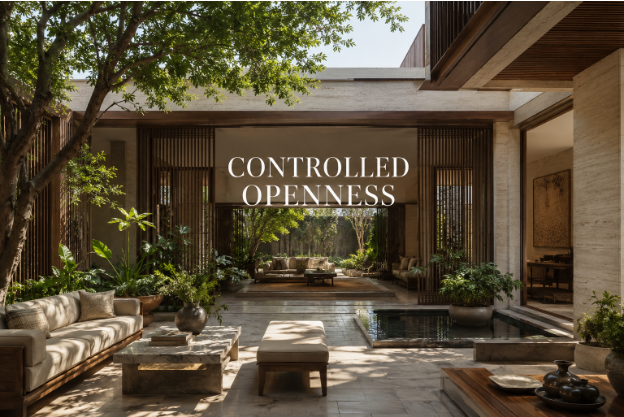
The Rise of the Outdoor Room
An outdoor room is different from a terrace or garden.
It is not just open space.
It has the same intentionality as an interior.
It needs:
- proportion
- privacy
- shade
- flooring
- lighting
- seating
- planting
- drainage
- airflow
- service access
- material durability
- connection to the home
A proper outdoor room is not an afterthought.
It is architecture.
Livingetc’s 2026 pergola trend coverage shows this direction clearly: pergolas are evolving into multifunctional outdoor rooms with lighting, heating, sound systems, louvered roofs, enclosed sides, hidden hot tubs, and real all-weather usability. These are no longer simple garden structures. They are becoming lifestyle rooms outside the house.
That shift matters because it changes the role of outdoor design.
The terrace is no longer just a terrace.
It becomes a lounge.
A dining room.
A wellness room.
A retreat.
A hosting space.
A private extension of daily life.
The Outdoor Room Must Be Designed Like an Interior
Most outdoor spaces fail because they are not designed with the same discipline as interiors.
Inside, every detail is considered:
- lighting
- furniture placement
- circulation
- material tone
- proportion
- storage
- comfort
- mood
Outside, the same discipline is often missing.
A few planters are added.
Some outdoor furniture is placed.
A pergola is installed.
Lights are added later.
That is not enough.
A real outdoor room must answer architectural questions:
Where will people sit?
What will they see?
How will the sun move?
Where will privacy come from?
How will water drain?
How will the space be used at night?
How will furniture survive weather?
How will service staff access it?
How will it remain clean?
How will it feel in summer, winter, and monsoon?
This is where high-end outdoor living becomes serious design.
Privacy Makes Outdoor Space Valuable
Outdoor space without privacy is rarely used well.
This is especially true in Delhi NCR.
A terrace may be large.
A garden may be beautiful.
A balcony may have potential.
But if the space feels exposed, people stop using it naturally.
They close curtains.
Avoid seating outside.
Use the space only for occasional hosting.
Treat it as visual area, not living area.
Privacy is what turns outdoor space into living space.
That privacy can come from:
- screens
- planting
- pergolas
- level changes
- deep parapets
- boundary design
- angled openings
- courtyard planning
- shaded verandahs
- framed sightlines
Recent coverage of outdoor privacy design highlighted sculptural slatted roofs and side panels that provide shade and seclusion while still allowing air, light, and connection to nature. That balance is important. Outdoor luxury should not feel closed. It should feel protected.
The best outdoor rooms offer controlled openness.
Not exposure.
Shade Is the Real Outdoor Luxury in India
In India, outdoor living cannot be copied blindly from European, Mediterranean, or Californian references.
Delhi NCR has a different reality.
Heat.
Dust.
Pollution.
Monsoon.
Glare.
Neighbouring buildings.
Maintenance pressure.
So the most important outdoor luxury is not openness.
It is shade.
Shade decides whether a terrace is usable or decorative.
Shade decides whether a courtyard is comfortable or harsh.
Shade decides whether a balcony becomes a room or a token feature.
This is why pergolas, deep overhangs, verandahs, trees, screens, chhajjas, slatted roofs, and layered planting are not just aesthetic details.
They are comfort infrastructure.
Indian architecture has always understood this. Traditional havelis and courtyard homes used internal courts, shaded edges, verandahs, high walls, and filtered light to create cooler, more private, and more usable living conditions in hot climates. Courtyards acted as lightwells, ventilation sources, family activity zones, and climatic moderators.
The modern luxury home is not inventing outdoor living.
It is rediscovering it.
Outdoor Living Supports Wellness
Outdoor rooms are also becoming important because luxury is becoming more wellness-led.
People want homes that help them recover.
Not just impress guests.
A shaded terrace can become a morning tea space.
A courtyard can become a breathing pause.
A pool deck can become daily movement.
A garden room can become a quiet evening retreat.
A balcony can become the quickest escape from indoor pressure.
Recent coverage of high-end lap pools frames them as restorative outdoor design, connecting movement, relaxation, wellness, and architecture rather than treating pools as decorative luxury.
That is the real value of outdoor rooms.
They give the home another emotional register.
Inside may provide comfort.
Outside provides release.
Outdoor Rooms Improve Hosting
Indian luxury homes are deeply connected to hosting.
Family dinners.
Festive gatherings.
Evening tea.
Winter brunches.
Pooja events.
Private parties.
Celebrations.
Informal conversations.
Outdoor rooms can elevate all of these.
But only if they are designed properly.
A terrace without lighting fails at night.
A garden without service access becomes difficult during events.
A pool deck without shade becomes seasonal.
A courtyard without seating becomes visual only.
A lawn without privacy becomes uncomfortable.
A balcony without depth becomes unusable.
Hosting is not created by space alone.
It is created by planning.
The best outdoor rooms understand:
- seating clusters
- guest circulation
- lighting mood
- food service
- weather protection
- acoustic comfort
- privacy
- staff movement
- visual connection to interiors
That is what makes them feel effortless.
Outdoor Rooms Increase Usable Luxury
This is one of the strongest value arguments.
A well-designed outdoor room increases the usable experience of a home without always increasing built-up area.
That matters.
Because luxury is no longer only about how much area is enclosed.
It is about how much life the home supports.
Outdoor rooms can create:
- a second living room
- a private dining court
- a wellness deck
- a work-break terrace
- a children’s play zone
- a family courtyard
- a guest entertaining area
- a shaded evening lounge
Pergola and outdoor-living trend coverage increasingly describes these spaces as functional additions that can improve how a home is used and even support property value when designed as real, weather-aware outdoor rooms.
That is a powerful idea for luxury homes.
Outdoor space is not extra.
It is usable luxury.
The Delhi NCR Reality
This topic is especially important in Delhi NCR.
Many luxury homes here have valuable outdoor potential:
- terraces
- setbacks
- courtyards
- balconies
- rooftops
- lawns
- pool decks
- verandahs
- farmhouse extensions
But much of this potential is underused.
Why?
Because Delhi NCR outdoor spaces often struggle with:
- heat
- dust
- pollution
- lack of privacy
- harsh sunlight
- monsoon exposure
- poor drainage
- maintenance difficulty
- neighbouring overlook
- weak lighting
- disconnected planning
That means outdoor design here cannot be superficial.
It must be climate-aware, privacy-aware, and maintenance-aware.
In Delhi NCR, outdoor luxury is not about open space.
It is about controlled openness.
The home must allow people to experience air, greenery, light, and sky without feeling exposed, overheated, or burdened by upkeep.
That is the real design challenge.
What Smarter Luxury Homes Do Differently
The best luxury homes now treat outdoor rooms as part of the main design system.
1. They Plan Outdoor Space Early
The terrace, courtyard, garden, and pool deck are not added at the end.
They are planned with the layout, façade, services, landscape, and lifestyle.
2. They Create Shade First
Before furniture, before styling, before decoration, they solve sun and heat.
Shade is the foundation of usable outdoor luxury.
3. They Design Privacy Into the Architecture
They do not rely only on tall walls.
They use screens, planting, angles, levels, pergolas, and spatial depth.
4. They Treat Furniture as Spatial Planning
Outdoor seating is not scattered.
It is composed like an interior room, with conversation zones, views, circulation, and comfort.
5. They Plan Lighting for Evening Use
Many outdoor spaces are beautiful in the day and dead at night.
Good lighting makes them usable after sunset.
6. They Choose Materials for Weather
Outdoor materials must survive heat, dust, rain, fading, staining, water, and cleaning.
Beauty is not enough.
Durability matters.
7. They Connect Outdoor Rooms to Daily Life
The best outdoor spaces are not isolated.
They connect naturally to bedrooms, lounges, dining spaces, kitchens, wellness zones, and family areas.
They become part of routine.
The New Luxury Interior Is Not Always Inside
This is the real shift.
The future luxury home is not a closed interior with landscaping around it.
It is a continuous living environment.
Inside and outside work together.
The living room extends into the courtyard.
The bedroom opens into a private balcony.
The dining area expands into a shaded terrace.
The wellness room connects to a pool deck.
The family lounge opens into a garden.
The home breathes through outdoor rooms.
That is what makes the home feel larger, calmer, and more complete.
Not just more area.
More life.