

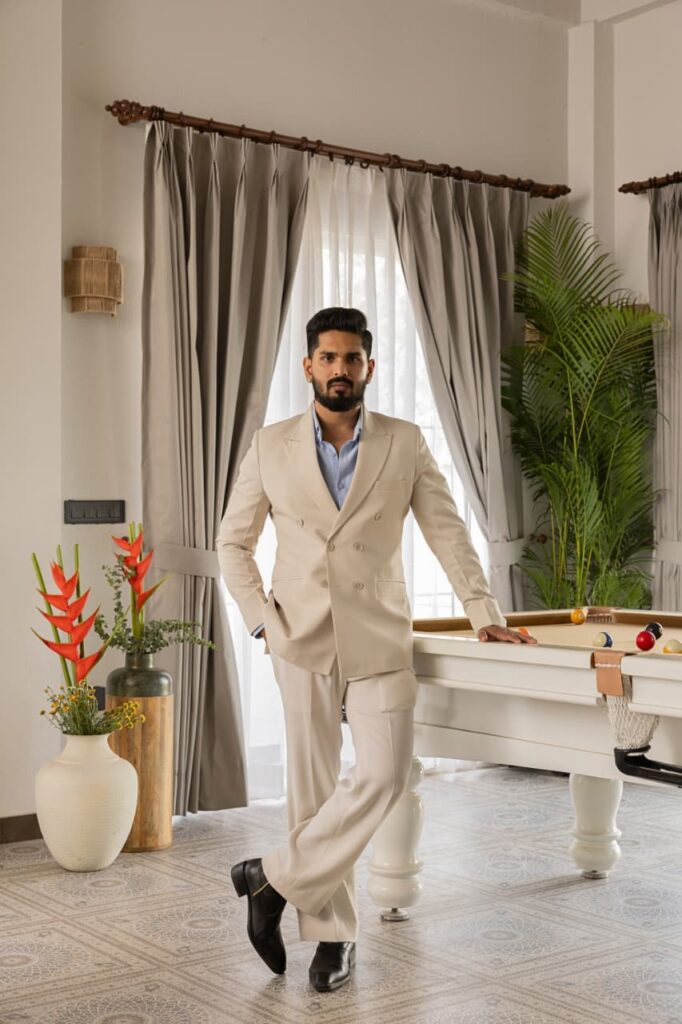
In the world of luxury architecture, the firms that ultimately shape cities are rarely the ones chasing visibility. They are the ones quietly building systems powerful enough to outlast trends, personalities, and market cycles. In a market where clients increasingly search for the best architect in Delhi and the best architect in India, companies are now judged not only by design, but by execution, integration, and consistency.
Founder and CEO Anmol CP Sachdeva built TAS World to represent a new generation of Indian luxury firms not around fragmented services, but around complete control of the architectural experience itself. From architecture and interior design to engineering, construction, project execution, and development strategy, the firm operates through a fully integrated model designed to deliver luxury environments with a level of coherence and precision still uncommon within India’s premium sector.
For Anmol CP Sachdeva, that integration is not a business feature. It is the foundation of what modern luxury architecture now demands.
“Architecture is not what you see. It is what you cannot explain — the feeling that a space was always meant to exist exactly as it does.”
— Anmol CP Sachdeva, Founder and CEO, TAS World
Rebuilding the Luxury Design Experience
India’s high-end residential and commercial sector has long operated through separation. Architects develop concepts. Interior designers reinterpret them. Consultants work independently. Contractors execute through layers of translation. By the time a project reaches completion, the original vision has often been diluted by operational disconnect between too many hands and too many interpretations.
Anmol CP Sachdeva saw this not merely as an inefficiency, but as a structural failure in the way luxury environments were being delivered in India. The client, spending significant wealth on their built environment, was absorbing every gap between every firm involved. The result was spaces that looked expensive but felt incoherent.Instead of building a traditional architecture studio, he structured TAS World as an end-to-end design-build organisation where architecture, interiors, engineering, execution, and construction operate as one synchronised intelligence. Architectural planning informs interior logic from the earliest stage. Engineering decisions support the design vision rather than reacting to it after the fact. Construction coordination begins alongside conceptual development rather than after approvals are complete.
“I do not collaborate with chaos. Every decision, every material, every line belongs to one intelligence and that intelligence does not compromise.”
— Anmol CP Sachdeva, Founder and CEO, TAS World
The result is not only stronger execution control, but a fundamentally different experience for clients operating at the premium and ultra-premium level. Today’s affluent Indian clients are deeply familiar with international standards of residential design. They have experienced luxury environments in London, Milan, Dubai, Singapore and New York. Increasingly, they expect the same level of sophistication, detailing, and operational precision from firms within India itself. TAS World was built to meet that expectation without apology. This shift reflects the growing demand for firms associated with the best architect in Delhi and best architect in India conversations, where clients expect globally benchmarked luxury design and execution.
Luxury Beyond Visual Excess
For years, luxury architecture in India was associated with scale, ornamentation, and expensive materials applied at volume. But a quieter transformation is now taking place among the country’s next generation of homeowners and business leaders.
The modern luxury client is moving beyond visual grandeur alone. They are seeking spaces that feel deeply personal, intelligently planned, emotionally resonant, and operationally refined. Homes are increasingly expected to function as extensions of identity, lifestyle, and long-term legacy rather than simply demonstrations of wealth
This evolution aligns precisely with the philosophy driving TAS World’s work under Anmol CP Sachdeva. Under his leadership, the firm approaches architecture not as isolated visual composition, but as the orchestration of experience across every layer of the built environment. Materiality, spatial flow, lighting, structural rhythm, climate responsiveness, detailing precision, functionality, and execution quality are treated as interconnected parts of a single design language.
“Anyone can make a space look expensive. The real question is whether it feels inevitable — whether every proportion, every material, every detail could not have been anything other than what it is. That is the standard I hold every project to.”
— Anmol CP Sachdeva, Founder and CEO, TAS World
The emphasis is not on creating spaces that appear luxurious in photographs alone, but on creating environments that maintain their integrity through daily living and long-term use. That mindset has helped position TAS World among the firms contributing to a broader redefinition of luxury architecture in India — one rooted less in excess and more in coherence, restraint, personalisation, and execution excellence.
Designing a Global Indian Identity
At the centre of Anmol CP Sachdeva’s long-term vision is a larger ambition: helping shape a more globally respected identity for Indian luxury design. As Indian luxury design gains global attention, conversations around the best architect in India are increasingly centered on firms that combine cultural depth with international standards.
India possesses one of the world’s richest architectural histories. The spatial intelligence of traditional havelis, the structural logic of Dravidian temple architecture, the precision of Mughal geometry, the climatic wisdom embedded in vernacular building traditions developed across centuries. Yet contemporary Indian luxury architecture has often struggled to establish a unified global identity of its own, frequently borrowing the visual language of Western or Gulf luxury rather than advancing its own.
Anmol CP Sachdeva believes the future lies not in imitation, but in the construction of a distinctly Indian design language capable of operating at international standards without losing cultural depth or contextual intelligence.
“India has always possessed extraordinary architectural intelligence. The future of Indian luxury architecture will not come from imitation. It will come from understanding our own spatial intelligence deeply enough to reinterpret it for a global era.”
— Anmol CP Sachdeva Founder and CEO, TAS World
This philosophy is reflected across TAS World’s work, where contemporary architectural language is balanced with material richness, proportion, warmth, and contextual sensitivity. The firm’s environments feel modern without becoming placeless, luxurious without becoming performative, and globally benchmarked while remaining rooted in the culture and climate of where they stand.
Building a Legacy, Not a Practice
What distinguishes enduring global design houses from practices that plateau is not only the quality of individual projects, but the strength of the systems, processes, and institutional thinking behind them. Anmol CP Sachdeva is building with both in mind simultaneously.
While architecture has historically remained a heavily personality-driven profession, TAS World is being developed with an operational mindset more commonly associated with scalable luxury companies than conventional design studios. Internally, the firm continues investing in structured workflows, project coordination systems, execution management, procurement integration, and process-driven accountability designed to maintain consistency as the organisation grows.
The ambition extends well beyond individual projects. TAS World is positioning itself as a long-term institution capable of delivering architecture, interiors, construction, and development strategy through one unified platform — the first call India’s ultra-wealthy make, not one name on a list of several.
“The organisations the world remembers were never built for their founders. They were built for the century.”
— Anmol CP Sachdeva, Founder and CEO, TAS World
That positioning reflects a broader shift taking place across the global luxury sector, where clients increasingly value firms that combine creative authority with operational reliability at scale. For India’s emerging luxury design landscape, that combination is fast becoming the defining competitive advantage.
The Future Already Under Construction
India’s luxury residential and commercial market is entering a period of accelerated transformation driven by rising wealth creation, global exposure, and a generation of clients with standards that simply did not exist in this country a decade ago. As the market matures, the firms most likely to define its future will not be those producing visually impressive projects alone, but those capable of delivering trust, precision, and complete architectural experiences from first brief to final key.
That is the space Anmol CP Sachdeva is building toward. At 29, with an integrated firm already operating across architecture, interiors, engineering, and construction, he represents a generation of Indian founders who understand that design alone is no longer enough, that the future belongs to those who can control the entire experience, from first brief to final detail, without compromise.
“Anyone can make a space look expensive. The real question is whether it feels inevitable.”
— Anmol CP Sachdeva, Founder and CEO, TAS World
His ambition is not limited to individual projects. It is directed toward something harder and rarer: building an institution capable of redefining how luxury is conceived, delivered, and experienced in India and on India’s own terms.
The global design world is only beginning to register what is taking shape at TAS World. But institutions built to last rarely announce themselves; they simply raise the standard until the standard is no longer in question.
Read This Full Article On Forbes