

Luxury homes are usually remembered by their grandest spaces.
The façade.
The living room.
The staircase.
The kitchen.
The bedrooms.
The landscape.
But the experience of a home begins before any of these.
It begins at the threshold.
The first few steps after arrival decide how the home receives people, filters movement, protects privacy, manages daily objects, and shifts the mind from the outside world into private life.
That is why entryways are becoming one of the most important transition zones in luxury homes.
Not just entrances.
Arrival architecture.
The Entrance Is Not the Entryway
The entrance is what people see from outside.
The entryway is what the home does after someone enters.
That difference matters.
An entrance may be beautiful.
A door may be impressive.
A façade may be grand.
But if the entryway does not manage shoes, bags, guests, deliveries, privacy, staff movement, security, and emotional transition, the home begins with friction.
A true luxury entryway must answer practical and psychological questions:
Where does a person pause?
What do they see first?
What remains hidden?
Where do shoes, bags, keys, and parcels go?
How are guests received?
How far can delivery staff enter?
How does the family move in daily life?
How does the home protect privacy from the main door?
A beautiful entrance creates an impression.
A well-designed entryway creates order.
The Threshold Has Always Had a Purpose
The idea of a threshold space is not new.
In architecture, vestibules and foyers have long acted as small transition rooms between outside and inside. Their purposes include waiting, withholding the larger interior from immediate view, reducing heat loss, and storing outdoor clothing or objects.
That historical function is still relevant.
Only now, the modern luxury entryway has more responsibilities.
It must manage:
- privacy
- arrival
- storage
- footwear
- bags
- guests
- service movement
- deliveries
- staff coordination
- security
- dust
- daily routines
- emotional decompression
The entryway is no longer a decorative passage.
It is the home’s first operating system.
Why Entryways Are Being Rethought Now
Current home design coverage is paying more attention to transition areas that were once ignored.
Good Housekeeping recently highlighted under-stair areas being transformed into dry bars, reading nooks, mudrooms, work corners, laundry areas, and entry drop zones. The larger message is clear: overlooked transition spaces are being redesigned for function, storage, and lifestyle value.
Good Housekeeping also covered mudroom and drop-zone ideas, noting that designers are using closed storage, benches, hooks, baskets, entry cabinets, and even main-floor laundry rooms to create more organized arrival spaces.
Ideal Home’s recent boot room coverage also shows the same direction. Boot rooms, once purely utilitarian, are now being treated as stylish extensions of the home, designed to manage outdoor-to-indoor movement while still feeling refined.
The trend is not simply “more storage.”
The real trend is smarter transition.
Homes are being asked to handle the mess of real life without allowing that mess to enter the emotional core of the home.
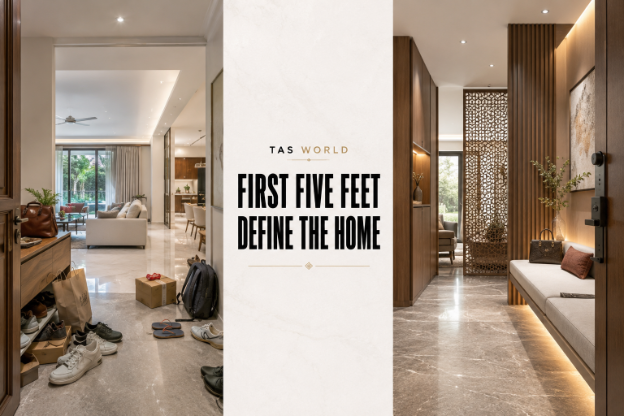
The First Five Feet Define the Home
The first five feet inside a home are extremely powerful.
This is where outside life enters.
Shoes.
Dust.
Keys.
Bags.
Packages.
Umbrellas.
School bags.
Office files.
Guest footwear.
Driver coordination.
Courier movement.
Daily clutter.
If this zone is not designed properly, disorder begins immediately.
The entrance console becomes a dumping spot.
Shoes collect near the door.
Courier boxes stay visible.
Bags land on chairs.
Keys disappear.
Guests see too much too quickly.
Family movement becomes messy.
This is why entryway design is not superficial.
It affects the entire home.
A luxury home should not begin with improvisation.
It should begin with clarity.
Entryways Protect Privacy
A badly designed entryway reveals too much.
The main door opens directly into the living room.
Guests see private family movement.
Delivery people look into the house.
Staff movement overlaps with guest arrival.
The formal and private zones blur from the first step.
This weakens the home’s privacy.
A luxury entryway should reveal the home gradually.
It should create a controlled sequence:
Arrival.
Pause.
Reception.
Orientation.
Then entry into the deeper home.
This can happen through:
- foyer walls
- screens
- artwork
- soft turns
- landscape buffers
- vestibules
- console placement
- lighting
- partial views
- courtyard glimpses
- privacy partitions
The best entryways do not expose the home instantly.
They create anticipation.
Entryways Are Psychological Decompression Zones
A person does not enter a home in a neutral state.
They enter from traffic, meetings, heat, dust, noise, social pressure, phone calls, decisions, and the constant speed of the outside world.
The entryway should help the body and mind transition.
From public to private.
From alert to calm.
From movement to pause.
From outside noise to inner order.
This is where luxury becomes emotional.
The entryway can create decompression through:
- warm lighting
- acoustic softness
- greenery
- scent
- seating
- natural materials
- art
- a water feature
- a quiet foyer volume
- a soft visual threshold
This connects with the broader design movement toward comfort, grounding, texture, and natural connection. Ideal Home’s boot room coverage, for example, links rich green tones and biophilic design with a desire for homes that feel calmer and more connected to nature.
An entryway should not only receive the body.
It should settle the mind.
Drop Zones Are Not Small Details
A drop zone may sound ordinary.
But in a high-end home, it is one of the most important invisible systems.
A drop zone handles daily objects before they invade the home.
It may include:
- concealed shoe storage
- key trays
- bag storage
- parcel placement
- umbrella storage
- coat hooks
- school bag space
- pet leash storage
- driver documents
- sanitizer or hygiene items
- daily mail
- guest footwear management
Good Housekeeping’s mudroom coverage specifically highlights the value of closed storage, entry cabinets, hooks, baskets, and defined drop zones for keeping arrival areas tidy and organized.
This matters deeply in Indian luxury homes.
Because entryways must handle more than décor.
They must manage daily family life.
Entryway Storage Must Be Designed, Not Added
Entry storage often fails because it is treated as furniture.
A shoe cabinet is placed later.
A console is added later.
Hooks are added later.
A bench is added later.
A tray is added later.
But luxury entry storage should be designed into the architecture.
Homes & Gardens’ entryway storage guidance emphasizes built-ins, wall-mounted storage, vertical solutions, seating, dedicated shoe cupboards, and single-purpose storage zones to keep the entryway calm and organized.
This is exactly the TAS World lens.
Entryway storage is not about hiding clutter after it appears.
It is about preventing clutter from becoming visible in the first place.
Elegance Requires Concealment
Entryways receive constant use.
That means they can become messy faster than almost any other zone in the home.
Better Homes & Gardens recently listed common entryway mistakes that reduce elegance, including insufficient lighting, bulky furniture, visible shoe piles, sports gear, too much open storage, and clutter from recycling bins. The article recommends warm layered lighting, concealed organizers, and more refined storage choices to keep the entryway functional and elegant.
That is an important luxury lesson.
A luxury entryway should not display the chaos of arrival.
It should absorb it.
Shoes should disappear.
Bags should have a place.
Packages should not sit in view.
Lighting should flatter the space.
Movement should remain clear.
Furniture should not block circulation.
This is where the best architects in Delhi and the best interior designers in Delhi can separate serious planning from surface styling.
The entryway must be beautiful because it works.
Not beautiful despite failing.
Luxury Homes Need More Than One Entry
A serious luxury home often cannot depend on one entrance.
Different types of arrival need different routes.
A high-end home may need:
- formal guest entry
- family entry
- staff entry
- service entry
- delivery access
- parking-to-home entry
- garden or pool access
- event entry
- utility access
One entrance cannot always carry all of this elegantly.
If guests, staff, groceries, deliveries, drivers, and family members all enter from the same point, the arrival experience becomes crowded.
The home loses hierarchy.
Luxury home planning in India must think about arrival as a system, not a door.
A formal guest should not experience the home the same way a delivery person does.
A family member coming from parking should not need to cross the formal foyer with bags and shoes.
Staff should have clear access without disturbing the main arrival.
This is not hierarchy for ego.
It is movement intelligence.
Entryways Are Also Security Filters
Security is often reduced to cameras, gates, and guards.
But architectural security is more subtle.
It is controlled progression.
A well-designed luxury home decides who can go how far.
Gate.
Driveway.
Porch.
Foyer.
Waiting area.
Formal room.
Family zone.
Private rooms.
Each layer should be intentional.
A poor entry sequence allows outsiders to see or enter too much too quickly.
A good entry sequence filters access with elegance.
Security should not make the home feel defensive.
It should make the home feel composed.
Entryways Support Indian Hospitality
In Indian homes, the entryway is not only functional.
It is cultural.
It is where guests are welcomed.
Where footwear may be removed.
Where elders are received.
Where festive arrivals begin.
Where flowers, light, fragrance, and hospitality create mood.
Where the home gives its first emotional signal.
A luxury entryway must feel gracious.
Not loud.
Not overdecorated.
Not exposed.
It should offer:
- a pause
- a clear welcome
- appropriate seating
- footwear logic
- privacy
- visual warmth
- dignified arrival
- easy guest movement
This is especially important in luxury home design India because hospitality is not occasional.
It is part of how homes live.
Material Choices Matter More at the Entry
The entryway receives heavy wear.
Foot traffic.
Dust.
Rain.
Luggage.
Shoes.
Pets.
Deliveries.
Guests.
Movement from outdoors.
So materials must be beautiful, but also durable.
Entry flooring, walls, handles, thresholds, rugs, benches, and storage finishes need to handle real use.
Ideal Home’s boot room coverage notes that darker, richer tones are practical because they help conceal scuffs and dirt in high-traffic transition spaces, while still creating a refined look.
That principle matters in luxury foyers too.
A delicate entryway that looks perfect only on the first day is not luxury.
It is fragility.
Real luxury survives arrival.
Lighting Defines the Arrival Mood
Lighting is one of the most underestimated parts of entryway design.
A harsh foyer feels commercial.
A dark foyer feels unwelcoming.
A flatly lit foyer feels ordinary.
A luxury entryway needs layered lighting:
- soft wall lights
- concealed cove glow
- statement but controlled ceiling lighting
- art lighting
- floor-level night lighting
- warm lighting near seating
- lighting that guides movement
Better Homes & Gardens also identifies poor or harsh lighting as one of the mistakes that weakens an elegant entryway.
The entryway should not shout.
It should glow.
Entryways Shape Daily Time
The entryway is used every day.
Multiple times.
Leaving for work.
Returning home.
Receiving guests.
Managing deliveries.
Sending children out.
Meeting drivers.
Taking off shoes.
Finding keys.
Picking up bags.
Collecting parcels.
If the entryway is poorly planned, the home wastes time daily.
Searching for keys.
Moving shoes.
Finding umbrellas.
Looking for bags.
Clearing parcels.
Asking staff where things are.
Adjusting around clutter.
These are small frictions.
But they repeat.
A luxury home should not make arrival and departure feel chaotic.
It should make them effortless.
The Entryway Should Not Reveal Everything
One of the biggest mistakes in modern homes is opening the front door directly into the main living space.
This may look spacious in a plan.
But it can feel exposed in real life.
A home needs mystery.
A sense of unfolding.
A controlled reveal.
This can be done through:
- an offset foyer
- a vestibule
- a partition wall
- a curved entry passage
- a courtyard glimpse
- art wall
- screen
- framed view
- indirect opening into the living room
A luxury home should not give itself away immediately.
It should let people arrive gradually.
The Best Entryways Are Quietly Multi-Functional
The modern entryway may need to perform many roles at once.
It may be:
- a welcome zone
- a privacy filter
- a drop zone
- a shoe zone
- a storage system
- a security layer
- a visual introduction
- a decompression space
- a guest waiting zone
- a family transition zone
This is why entryways deserve architectural attention.
They are not small spaces.
They are high-impact spaces.
What Smarter Luxury Homes Do Differently
1. They Create a Proper Arrival Sequence
The home does not jump from road to living room.
It creates progression: gate, driveway, porch, foyer, then interior.
2. They Separate Entry Types
Guest, family, staff, delivery, and service movements are planned with clarity.
3. They Hide Daily Clutter
Shoes, bags, parcels, keys, and daily objects have dedicated places before they enter the main home.
4. They Protect Privacy
The entryway prevents direct views into family lounges, bedrooms, kitchens, and private areas.
5. They Use Durable Materials
Entry finishes are selected for dust, wear, luggage, scuffs, moisture, and foot traffic.
6. They Use Lighting as Atmosphere
The foyer is lit to feel calm, warm, and composed, not harsh or theatrical.
7. They Design for Indian Rituals
Footwear, guests, festivals, deliveries, staff movement, and hospitality are considered from the beginning.
8. They Make the First Pause Feel Intentional
A good entryway gives people a moment to arrive before entering the deeper home.
The New Definition of a Luxury Entryway
A luxury entryway is not just a decorated entrance.
It is a system of arrival.
It manages objects.
It protects privacy.
It filters movement.
It creates calm.
It welcomes guests.
It supports family routines.
It separates service from ceremony.
It turns arrival into architecture.
This is what makes it powerful.
The entryway is the first place where the home proves whether it has been designed for life, not just appearance.