

In luxury residential architecture, privacy is no longer a secondary consideration.
For many homeowners today, it is one of the most important design priorities.
Modern cities are denser than ever. Streets are more visible. Social media has made personal spaces increasingly exposed.
As a result, high-end homes are no longer designed simply to impress from the outside. They are designed to protect the lives within.
Privacy has become an architectural discipline.
The Shift From Display to Discretion
In the past, luxury homes often emphasized visibility.
Grand façades facing the street.
Large windows displaying interiors.
Symmetrical entrances designed to impress passers by.
Today, the philosophy has evolved.
Many luxury homeowners prefer a quieter approach. They want homes that reveal themselves gradually rather than announcing themselves immediately.
This shift has influenced how architects design entrances, façades, and spatial sequences.
Luxury is becoming more discreet.
Layered Entry Sequences
One of the most effective privacy strategies is a layered arrival experience.
Instead of exposing the main entrance directly to the street, architects create a series of transitions.
Boundary walls or landscape buffers soften the edge between public and private space.
Driveways may curve slightly, delaying direct views into the home. Entry courtyards often provide a transitional zone where visitors pause before entering the interior.
These layered sequences increase both privacy and architectural drama.
The home feels protected yet welcoming.
Strategic Window Placement
Glass façades are often associated with modern luxury architecture.
However, intelligent window placement ensures that openness does not compromise privacy.
Windows are positioned to capture views of gardens, courtyards, and landscape features rather than neighboring properties.
High-level glazing can introduce daylight without exposing interiors to street views.
In dense urban settings, architects often combine glass with screens, louvers, or textured materials to filter visibility.
This balance allows homes to remain bright while maintaining discretion.
Courtyard Architecture
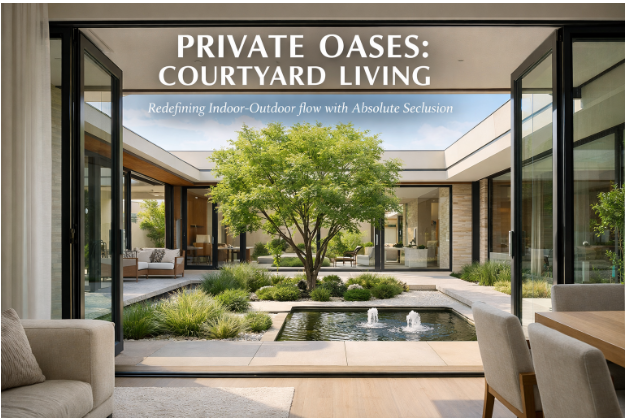
Courtyard planning has long been part of traditional architecture across many cultures.
In contemporary luxury homes, courtyards are experiencing renewed interest.
They create private outdoor environments enclosed within the home’s architecture.
Residents can enjoy open-air spaces without exposure to surrounding streets or neighboring buildings.
Courtyards also improve natural ventilation and daylight distribution.
They become the quiet heart of the home.
Landscape as a Privacy Layer
Landscape design plays a crucial role in residential privacy.
Carefully positioned trees, hedges, and vertical planting can block sightlines while preserving openness.
Water features and garden walls further reinforce spatial separation.
Unlike solid barriers, landscape elements soften boundaries while maintaining visual elegance.
The result is a home that feels protected without appearing defensive.
Zoning Within the Home
Privacy is not only about protecting the home from the outside world.
It also influences how spaces function internally.
Luxury homes often require multiple zones to accommodate different lifestyles.
Family areas
Guest entertainment zones
Private suites
Home offices
Staff circulation paths
Thoughtful zoning ensures that daily life flows smoothly without unwanted overlap.
For example, private bedrooms remain insulated from social gatherings. Home offices maintain quiet separation from family activity.
Architecture organizes privacy.
Security Through Design
Security systems are essential in high-end homes, but architecture plays an equally important role.
Controlled entry points, discreet surveillance integration, and layered boundaries enhance safety without disrupting aesthetics.
Instead of visible security equipment dominating the property, protection is embedded within the design itself.
Perimeter walls, lighting strategies, and circulation planning all contribute to a safer environment.
Good architecture anticipates risk before technology intervenes.
The Emotional Value of Privacy
Privacy is not only practical.
It is emotional.
A home that feels sheltered allows residents to relax fully. Conversations feel quieter. Outdoor spaces feel more personal.
In a world of constant connectivity, private environments have become a form of luxury.
Architecture creates the conditions for that calm.
Privacy as a Modern Luxury Standard
Luxury residential architecture is evolving toward more thoughtful and discreet design.
Rather than focusing solely on visual spectacle, modern homes emphasize comfort, protection, and personal space.
Courtyards replace exposed lawns. Landscapes soften boundaries. Spatial zoning supports everyday life.
These strategies create homes that feel both open and secure.
Pingback: Why Privacy Must Be Designed Into a Luxury Home, Not Added Later - TAS World