

Delhi’s monsoon is not gentle.
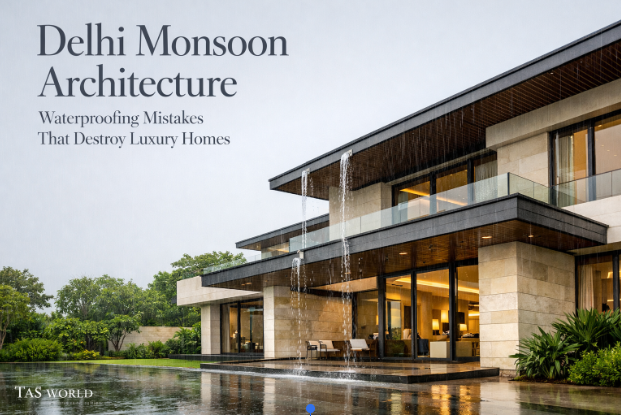
Short bursts of intense rainfall, clogged urban drainage systems, rising humidity, and water stagnation create significant stress on residential structures. For luxury villas in Delhi NCR, the risk is amplified.
Basements, terraces, skylights, large facade openings, imported cladding systems these architectural features increase complexity. When waterproofing is treated casually, the damage is rarely immediate. It surfaces months later as stains, swelling, cracks, and structural deterioration.
Water damage in a luxury home is not cosmetic.
It is capital erosion.
Here are the most critical waterproofing mistakes that compromise high-end residences in Delhi.
1. Inadequate Basement Waterproofing Systems
Basements are highly vulnerable during monsoon due to hydrostatic pressure buildup around foundation walls.
Common failures include:
Single-layer membrane systems
Improper joint sealing
Lack of pressure relief planning
No drainage boards behind retaining walls
When groundwater accumulates against basement walls, even minor membrane gaps allow seepage.
Luxury villa architecture in India increasingly incorporates basements for parking, entertainment rooms, or wellness spaces. These areas demand layered waterproofing strategies that combine:
External membrane systems
Protective screed layers
Drainage channels
Sump pump planning
Basement waterproofing must be engineered during design, not improvised during construction.
2. Improper Terrace Waterproofing and Slope Planning
Flat roofs are common in modern luxury homes in Delhi NCR.
During monsoon, water stagnation is the primary threat.
Mistakes include:
Incorrect slope calculation
Insufficient drainage outlets
Single membrane applications
Improper tile installation over waterproof layers
Terraces must include precise slope gradients directing water toward drainage points. Even minor deviations create pooling zones that weaken membranes over time.
In high-end residential architecture, terrace waterproofing is not a vendor task. It is an architectural decision tied to long-term durability.
3. Poor Facade Joint Detailing
Luxury facades often feature:
Natural stone cladding
Metal panel systems
Glass curtain walls
Complex geometric transitions
Water infiltration rarely occurs through large cracks. It enters through micro gaps at joints.
Without proper sealant specification, expansion allowance, and flashing details, rainwater seeps into wall cavities.
This leads to:
Internal damp patches
Efflorescence on stone
Material discoloration
Long-term structural stress
Façade detailing is where architectural precision protects value.
4. Ignoring Drainage and Site Grading Strategy
Waterproofing begins outside the building envelope.
Common site-level mistakes include:
Landscape slopes directing water toward the structure
Improper plinth height
Blocked rainwater harvesting pits
Inadequate surface drainage planning
Luxury homes in Delhi NCR often invest heavily in façade aesthetics but overlook ground-level hydrology.
Water should always be directed away from the foundation. Site grading is not landscaping. It is structural protection.
5. Inappropriate Material Selection for Humid Conditions
Delhi’s monsoon brings sustained humidity.
Certain materials react poorly in this environment:
Moisture-sensitive veneers
Untreated wood surfaces
Low-grade plaster systems
Improper insulation boards
Luxury interior finishes can swell, stain, or detach when moisture penetrates from external walls.
Residential architects in Delhi NCR must evaluate material performance not only in dry summer heat but also in monsoon humidity cycles.
Durability protects luxury.
6. Weak Window, Skylight, and Parapet Flashing
Architectural openings are high-risk zones.
Skylights, large sliding windows, and parapet walls require precise flashing details.
Frequent mistakes include:
Improper slope under window sills
Incomplete sealant curing
No secondary flashing layers
Improper integration between frame and wall
Water penetration at openings is subtle and progressive. It may take months before visible damage appears.
Luxury homes often incorporate dramatic skylight voids and glass expanses. These features demand engineering-level detailing, not decorative installation.
7. Absence of Waterproofing Supervision on Site
Even the best waterproofing design fails without execution discipline.
Common on-site failures include:
Incomplete membrane overlaps
Poor curing time before covering layers
Improper joint treatment
No water testing before final finishes
Waterproofing must be inspected at every stage.
Design-build firms in Delhi NCR often manage this more effectively because architectural intent and execution are integrated.
Without structured supervision, waterproofing becomes vulnerable to shortcuts.
8. Treating Waterproofing as a Vendor Add-On
The most dangerous mistake is conceptual.
Waterproofing is often outsourced late in the project timeline as a subcontractor task.
In reality, it should be embedded in:
Foundation planning
Wall section detailing
Roof design
Drainage coordination
Material selection
In luxury residential architecture, waterproofing strategy must begin at schematic design stage.
When integrated early, it protects the entire structure. When delayed, it becomes reactive and expensive.
The Financial Impact of Monsoon Negligence
Water damage in high-end homes leads to:
Repeated repair cycles
Interior material replacement
Structural corrosion
Reduced resale value
Rectifying basement or façade water infiltration can cost significantly more than implementing proper systems initially.
For luxury villa construction in Delhi NCR, monsoon resilience is not an optional upgrade.
It is asset protection.
Architecture That Anticipates Weather
Delhi’s climate presents two extremes:
Intense summer heat
Heavy seasonal rainfall
Luxury architecture must respond to both.
Monsoon-resistant design requires:
Integrated drainage systems
Layered waterproofing
Material intelligence
Precise façade detailing
Disciplined execution
The best architects in Delhi understand that performance is invisible when done correctly.
You notice waterproofing only when it fails.